
Your Complete CPQ Administrator Snapshot
The Salesforce Certified CPQ Administrator exam validates expertise in implementing Salesforce CPQ (Configure, Price, Quote) and the ability to expertly design, build, and implement quoting flows. In 2026, it covers eight domains: CPQ Platform (23%), Bundle Configurations (17%), Pricing (20%), Quote Templates (8%), Product Selection (10%), Renewals, Amendments, and Orders (7%), Products (8%), and Approvals (7%). A passing score of 65% is required (39 out of 60 scored questions). The exam costs $200 USD with a $100 retake fee. A typical preparation window is 8-12 weeks for those with CPQ experience, though beginners may need 12-16 weeks. The recommended study path combines official Trailhead learning with extensive hands-on practice in a CPQ Developer Edition org and comprehensive practice exams. The certification must be renewed annually via release maintenance modules. This guide details official resources, practical implementation strategies, exam policies, and career opportunities in the high-demand CPQ specialization within the Salesforce ecosystem.
Introduction: What is the Salesforce Certified CPQ Administrator and Why Does It Matter?
The Salesforce Certified CPQ Administrator certification represents specialized expertise in one of Salesforce’s most powerful and complex managed packages. CPQ (Configure, Price, Quote) transforms how organizations with complex product catalogs generate accurate quotes, manage sophisticated pricing models, and streamline the quote-to-cash process. This credential validates your ability to implement and optimize CPQ functionality that directly impacts sales productivity and revenue accuracy.
This certification matters because CPQ is notoriously complex, and businesses implementing it need professionals who truly understand its intricacies. Unlike standard Salesforce administration, CPQ requires deep knowledge of product bundles with nested configurations, multi-dimensional pricing strategies, automated discount calculations, dynamic quote generation, subscription management, and the complete quote-to-order-to-renewal lifecycle. Organizations cannot afford CPQ implementations that fail or produce inaccurate quotes, the financial stakes are simply too high.
For professionals, this certification opens doors to specialized, high-paying roles. CPQ skills command premium compensation because the talent pool is smaller and the business impact is substantial. For organizations, certified CPQ Administrators reduce implementation risk, optimize pricing strategies, improve sales efficiency, and ensure complex product configurations translate into accurate revenue recognition.
The certification demonstrates you can handle real-world challenges: building dynamic bundles that adjust based on user selections, implementing pricing waterfall logic that applies discounts in the correct sequence, creating quote templates that generate professional documents, managing subscription renewals and mid-term amendments, and troubleshooting data flow issues across CPQ’s interconnected object model.
Quick Facts & Exam Details
| Detail | Information |
|---|---|
| Exam Name | Salesforce Certified CPQ Administrator (Sales-Admn-202) |
| Provider | Salesforce |
| Prerequisites | None required. Salesforce Administrator certification or equivalent experience is strongly recommended. At least 6-12 months of hands-on CPQ implementation experience is ideal for exam success. |
| Passing Score | 65% (approximately 39 out of 60 scored questions correct) |
| Exam Duration | 105 minutes |
| Question Types | Multiple-choice and multi-select scenario-based questions (60 scored questions plus up to 5 unscored) |
| Exam Cost | $200 USD plus applicable taxes. Retake fee: $100 USD. Note: Prices vary by country and are subject to change. Always confirm the final cost during the registration process through Pearson VUE. |
| Delivery Options | Online proctored exam or onsite at a Pearson VUE testing center |
| Reference Materials | No external materials permitted during the exam |
Is This Certification Right for You? (Target Audience)
This certification is designed for professionals who implement, configure, and support Salesforce CPQ solutions. You should consider pursuing this credential if you:
- Currently work as a Salesforce Administrator supporting an organization that uses or plans to implement CPQ for complex product quoting
- Serve as a CPQ Implementation Consultant either internally or for a Salesforce partner organization, responsible for configuring CPQ to meet client requirements
- Work in Sales Operations and need to understand how to optimize CPQ configurations, pricing strategies, and quoting workflows to improve sales efficiency
- Are a Salesforce Developer who works with CPQ implementations and wants to formalize your understanding of declarative CPQ configuration alongside your coding skills
- Hold a role as a Business Analyst or Solutions Architect designing quote-to-cash processes that leverage CPQ capabilities
- Want to specialize in a high-demand niche within the Salesforce ecosystem that commands premium compensation due to complexity and business criticality
The exam assumes you have hands-on experience implementing CPQ, not just theoretical knowledge. You need practical understanding of how product bundles behave, how pricing rules execute in sequence, how quote templates generate documents, and how data flows between CPQ objects. While the exam doesn’t test coding, you should understand when custom Apex might be necessary versus what declarative tools accomplish.
This is not an entry-level certification despite having no formal prerequisites. Candidates with minimal CPQ experience typically struggle significantly. The ideal candidate has implemented at least one complete CPQ project from discovery through deployment and has troubleshot real-world CPQ issues.
Exam Blueprint: Skills You’ll Be Tested On
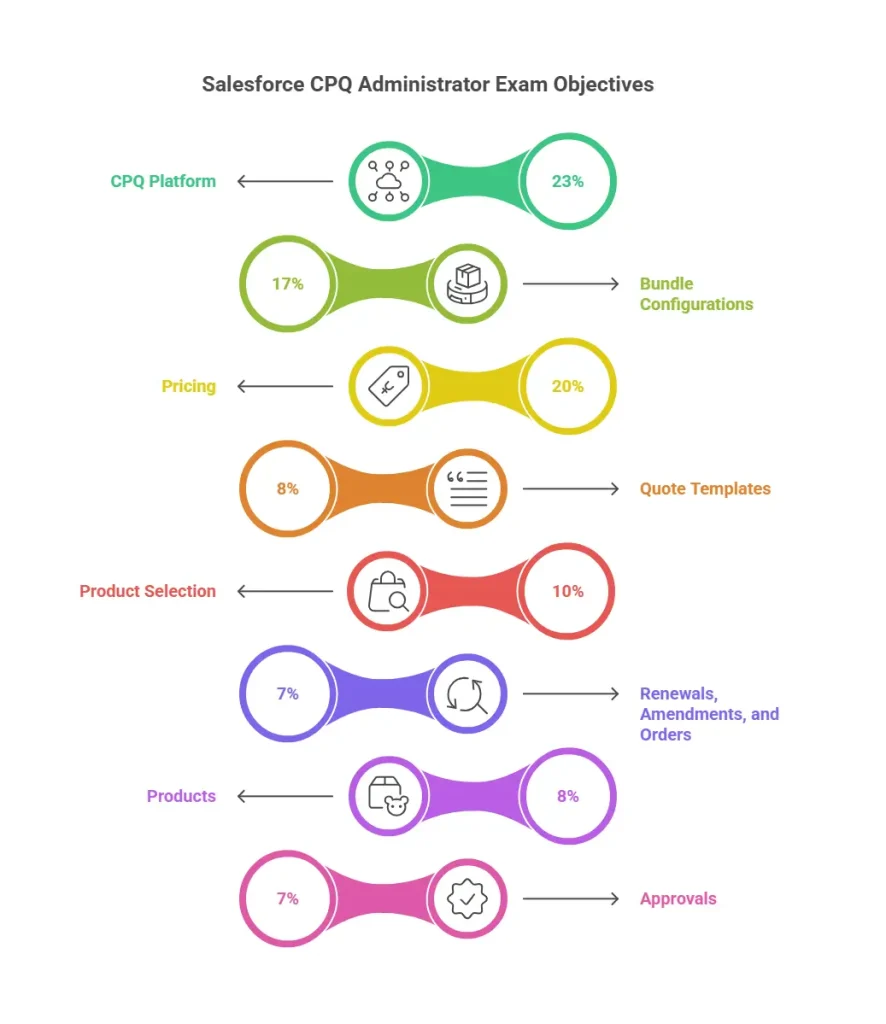
Domain 1: CPQ Platform (23%)
This is the largest domain and tests your foundational understanding of how CPQ operates within a Salesforce org. You must demonstrate knowledge of designing, configuring, and troubleshooting Price Rules using lookup objects and formula fields to meet complex business requirements. Understanding the quote calculation sequence is critical, you need to know exactly when Price Rules execute, how Quote Line fields calculate, and how to predict pricing outcomes. This domain covers CPQ permissions, including how to properly clone, customize, and assign CPQ permission sets based on user roles. You must understand Record Types for quotes and opportunities, know how to customize Field Sets for the Line Editor and Summary Fields, and create custom fields on the Quote object to enable dynamic field displays. The domain tests your knowledge of CPQ data flow across objects, particularly twin fields that automatically synchronize data between related records. You should understand how quote sync works, what happens when the Primary checkbox is selected, and common troubleshooting steps when opportunity products fail to sync. Package-level settings knowledge is essential, you need to know which settings control global CPQ behavior. Finally, understand how to configure multi-currency and localization settings, and explain how the CPQ managed package fits within a Salesforce org’s overall architecture.
Domain 2: Bundle Configurations (17%)
This domain validates your ability to set up product bundle structures to meet various business requirements. You must understand the relationship between parent products, Product Options, and Product Features. Know when to use Configuration Attributes to capture user input during product configuration and how these attributes drive bundle behavior. Product Rules are heavily tested, you need to demonstrate how to configure Selection, Validation, Filter, and Alert Rules that ensure bundles work properly. Understand Option Constraints including dependencies (this product requires that product), exclusions (this product cannot coexist with that product), and dependency cardinality. Know how to implement dynamic bundles that adjust based on user selections, understanding when products should be required, optional, or hidden based on other choices. This domain tests practical scenarios: “A company sells software with optional add-ons. Premium Support requires either Gold or Platinum Service Level. How do you configure this?” You need to know exactly which Product Rule type to use and how to structure the logic.
Domain 3: Pricing (20%)
This is the third largest domain and covers comprehensive pricing strategy implementation. You must identify appropriate pricing methods for different scenarios: when to use Discount Schedules (tiered discounts based on quantity or term), Block Pricing (different pricing for quantity ranges), Contracted Prices (customer-specific negotiated pricing), Subscription Pricing (recurring revenue models), Percent-of-Total (pricing based on total quote value), and Usage-Based Pricing. Understanding the pricing waterfall is essential, you need to know the sequence in which list price, customer price, special price, contracted price, partner discounts, volume discounts, and Price Actions execute. Predict pricing outcomes given complex scenarios with multiple pricing dimensions. Know how to construct Price Rules including how to use lookup queries against custom objects, formula fields for dynamic calculations, and Price Conditions to control when rules fire. Understand Price Actions that modify quote line fields. This domain tests your ability to troubleshoot pricing issues: “Why isn’t my Price Rule firing?” or “Why is my contracted price being overridden?” Understanding the relationship between Price Books, Price Book Entries, and CPQ pricing logic is critical.
Domain 4: Quote Templates (8%)
This section validates your knowledge of creating professional quote documents. You must understand how to set up Quote Templates using Quote Terms, Line Columns, Template Sections, and Content that meets business document requirements. Know how to configure conditional sections that display only when certain criteria are met. Understand how to use template variables to dynamically insert data, how to format line items for clear presentation, and how to create multi-page templates with headers, footers, and page breaks. This domain covers integration with document generation tools and how to troubleshoot template rendering issues. While smaller in weight, this domain contains tricky questions about template inheritance, how quote lines group into sections, and how to display calculated totals and subtotals.
Domain 5: Product Selection (10%)
This domain tests your ability to enable efficient product discovery and configuration. You must demonstrate knowledge of Search Filters that help sales reps find products quickly in large catalogs. Understand how to configure Field Sets that control which product fields display during product selection and what information appears in the Line Editor. Know how to implement Custom Actions that provide additional functionality during product selection or line editing. This domain covers how products display on the selection page, why certain products might not appear, and how to troubleshoot product visibility issues. Understanding how Search Filters chain together with AND/OR logic and how to create dynamic filters based on quote or opportunity fields is essential.
Domain 6: Renewals, Amendments, and Orders (7%)
While this is a smaller domain, questions can be particularly tricky. You must understand the complete renewal process: how renewal quotes generate automatically or manually, how renewal pricing differs from initial pricing, and how to configure renewal pricing models. Amendments are complex, you need to know how to allow customers to add products mid-contract, remove products, or change quantities, and how these changes affect contract values and subscription terms. Understand the ordering and contracting process, including how to generate Orders from Quotes, how contracted quantities track against orders, and how to enable multiple orders from a single quote. This domain tests practical scenarios about co-terming subscriptions, prorating amendments, and handling cancellations.
Domain 7: Products (8%)
This section covers how to properly set up the product catalog that drives CPQ functionality. You must demonstrate knowledge of Products, Price Books, and Price Book Entries, including how to create products with the correct options selected for CPQ functionality. Understand product fields that control CPQ behavior: Subscription Pricing checkbox, Subscription Term, Subscription Type, Exclude From Opportunity, Optional, Component, and others. Know how product catalog setup impacts overall CPQ data flow, including which products sync to opportunities and which don’t. Understand how product search works, why products might not display during product selection, and how to troubleshoot product configuration issues. This domain often includes questions about the relationship between standard Salesforce product objects and CPQ-specific product functionality.
Domain 8: Approvals (7%)
This domain tests your knowledge of implementing approval processes for quotes. You must understand the difference between Native Approvals (standard Salesforce approval processes) and Advanced Approvals (CPQ-specific approval functionality with delegated approvers, approval chains, and recall capabilities). Know when to recommend each type based on business requirements. Understand how to configure approval conditions, approval levels, and what happens when quotes require multiple approvals. This section covers how approvals integrate with quoting workflows and how to troubleshoot approval process issues.
Your Strategic Study Plan for Success
Phase 1: Foundation and Environment Setup (Week 1)
Download the official Salesforce Certified CPQ Administrator Exam Guide from Trailhead and review it thoroughly. This document lists every objective you’ll be tested on. Use it as your master checklist throughout your preparation.
Most critically, you must set up a CPQ Developer Edition org. This is non-negotiable for exam success. Standard Developer Edition orgs and Trailhead Playgrounds do not include CPQ. You must specifically request a CPQ-enabled org through the Salesforce Developer Program or through specific Trailhead modules that provision CPQ orgs. Without hands-on access to CPQ, passing this exam is nearly impossible.
Complete the Trailhead trail “CPQ Administrator Fundamentals” to build your foundational knowledge. This covers CPQ basics, product configuration, pricing, and quote generation. Take notes on concepts that feel unclear, you’ll revisit these during hands-on practice.
Bookmark the official Salesforce CPQ Documentation and familiarize yourself with its structure. You’ll reference this extensively throughout your preparation.
Phase 2: Deep Domain Study with Hands-On Practice (Weeks 2-6)
Dedicate each week to specific domains, prioritizing based on exam weight. Spend Week 2 on CPQ Platform (23%), Week 3 on Pricing (20%), Week 4 on Bundle Configurations (17%), Week 5 on Product Selection (10%) and Products (8%), and Week 6 on remaining domains.
For CPQ Platform, build multiple Price Rules in your org. Create rules with lookup queries to custom objects, use formula fields for calculations, experiment with Price Conditions, and understand how evaluation order affects outcomes. Practice the complete quote calculation sequence by creating quotes and examining how fields populate at each stage. Configure permission sets, customize Field Sets, create custom Record Types, and experiment with quote sync troubleshooting.
For Pricing, implement every pricing method. Create Discount Schedules with quantity-based tiers, Block Pricing with slab structures, Contracted Prices for specific accounts, and Subscription Pricing models with different term options. Build Price Rules that modify pricing and understand exactly when they execute in the pricing waterfall. Create scenarios where multiple pricing factors interact and predict the outcome.
For Bundle Configurations, build increasingly complex bundles. Start with simple parent-child relationships, add Configuration Attributes, implement all four Product Rule types, create Option Constraints, and test dynamic bundle behavior. Break your bundles intentionally to understand error messages and troubleshooting. The ability to diagnose why a bundle isn’t behaving as expected is critical for the exam.
For each domain, don’t just follow tutorials, create your own scenarios and solve problems independently. This builds the problem-solving intuition the exam tests.
Phase 3: Official Trailhead Content and Integration (Weeks 7-8)
Complete the official Trailhead trailmix “Prepare for Your Salesforce CPQ Specialist Credential.” This curated collection covers exam objectives with hands-on challenges. The modules include built-in quizzes that mirror exam question styles.
Focus on integration topics: how CPQ data flows between objects, how twin fields work, how quotes sync with opportunities, how orders generate from quotes, how renewals create from contracts, and how amendments modify existing subscriptions. Build end-to-end scenarios in your org where you create an opportunity, add products, generate a quote, activate it, create an order, amend the contract, and generate a renewal. Understanding this complete lifecycle is essential.
Study the CPQ object model diagram. Understand relationships between Opportunity, Quote, Quote Line, Product, Product Option, Order, Contract, Subscription, and Asset objects. Know which objects are standard Salesforce and which are CPQ-specific.
Phase 4: Practice Exams and Targeted Review (Weeks 9-12)
Take your first full-length practice exam from Focus on Force, saasguru, or other reputable providers. These resources offer scenario-based questions that closely mirror actual exam difficulty. Your goal is to establish a baseline score and identify weak areas.
Analyze every practice question regardless of whether you answered correctly. Read explanations thoroughly, click through to referenced documentation, and if something is unclear, test it in your CPQ org. Many candidates report that understanding WHY wrong answers are wrong proves more valuable than memorizing correct answers.
Create a targeted study plan based on practice exam results. If you scored below 70% on Pricing, return to your org and rebuild pricing scenarios until the logic becomes intuitive. If Bundle Configurations confused you, build more complex bundles and test edge cases.
Take 2-3 additional full-length practice exams under timed conditions during your final weeks. Aim for consistent scores of 85% or higher before scheduling your actual certification attempt. The exam is challenging enough that you want a comfortable margin above the 65% passing threshold.
Join the Salesforce CPQ Trailblazer Community group to discuss concepts with other professionals. Many experienced CPQ professionals share insights and answer questions.
Phase 5: Final Preparation (Days Before Exam)
Review your notes, flashcards, and any summary documents you’ve created. Focus on areas that remain challenging. Many candidates create cheat sheets summarizing Product Rule types, Price Rule execution order, the quote calculation sequence, and twin field requirements.
Review the pricing waterfall one final time, this is one of the most commonly tested concepts. Ensure you can explain the exact sequence of pricing calculations and when each pricing element applies.
Practice time management. With 60 questions in 105 minutes, you have approximately 1.75 minutes per question. Scenario-based questions with long setup text require careful reading, so practice pacing during your mock exams.
Get adequate rest the night before. CPQ exam questions are dense with detail, and mental fatigue significantly impacts performance. Arrive (virtually or physically) relaxed and focused.
Career and Salary Opportunities
The Salesforce CPQ Administrator certification positions you within one of the highest-paying specializations in the Salesforce ecosystem. CPQ expertise commands premium compensation because the skill set is complex, the talent pool is limited, and the business impact is substantial. Organizations implementing CPQ need professionals who truly understand the platform’s intricacies.
According to current salary data from ZipRecruiter, Glassdoor, and Salary.com, CPQ professionals in the United States enjoy competitive compensation at all experience levels. Entry-level positions such as Junior CPQ Administrator or CPQ Support Specialist typically offer salaries ranging from $75,000 to $95,000 annually. These roles involve supporting existing CPQ implementations, making configuration changes, troubleshooting user issues, and assisting with quote generation processes.
Mid-level CPQ Administrators and CPQ Specialists with 2-4 years of experience generally earn between $90,000 and $120,000 per year. At this level, you’re expected to independently configure CPQ features, implement new pricing strategies, build complex product bundles, create quote templates, and lead portions of CPQ projects. Many mid-level professionals work as consultants, gaining exposure to different industries and implementation patterns.
Senior CPQ Administrators, CPQ Consultants, and CPQ Solution Architects with 5+ years of experience command salaries between $120,000 and $150,000 or more annually. Senior roles involve architecting complete CPQ solutions, leading implementations, mentoring junior team members, optimizing existing CPQ instances for performance and user experience, and integrating CPQ with billing systems, ERP platforms, and other enterprise applications.
Specialized CPQ roles at major consulting firms like Accenture, Deloitte, and Capgemini often offer even higher compensation, particularly for professionals who combine CPQ expertise with industry knowledge (manufacturing, technology, telecommunications, healthcare). Some job postings for Senior CPQ Consultants and CPQ Engagement Managers show salary ranges up to $205,000 for highly experienced professionals.
Location significantly impacts compensation. CPQ professionals in major metropolitan areas like San Francisco, New York, Boston, Seattle, and Chicago typically earn 20-30% more than national averages, though remote positions have somewhat normalized geographic pay differences.
Contract and freelance CPQ consultants can command $80-150 per hour depending on experience and project complexity. Many experienced professionals transition to independent consulting, offering flexibility alongside higher effective compensation.
The job market for CPQ professionals remains robust. Salesforce CPQ continues gaining market share as organizations seek to streamline complex quoting processes. LinkedIn and Indeed consistently show hundreds of active positions seeking CPQ expertise. Demand is particularly strong in industries with complex product catalogs: technology (software as a service), manufacturing (industrial equipment with configurations), telecommunications (bundled services), financial services (complex product packages), and healthcare (medical devices and services).
Career progression typically follows several paths. Many professionals advance from CPQ Administrator to Senior Administrator or Lead Administrator roles, then move into CPQ Consultant positions at major consultancies. Others progress to Solution Architect roles, combining CPQ knowledge with broader Salesforce architecture expertise. Some transition into Product Owner or Business Analyst roles focused on quote-to-cash process optimization. A smaller number move into CPQ Developer positions, combining declarative configuration with custom Apex development.
The CPQ certification paired with complementary credentials (Administrator, Advanced Administrator, Sales Cloud Consultant, Platform App Builder) creates a powerful combination that commands premium compensation and job security. As organizations increasingly rely on CPQ for revenue accuracy, certified professionals who truly understand the platform become indispensable.
Exam Logistics: Policies You Need to Know
Registration and Scheduling: Register through the Salesforce Certification Program which partners with Pearson VUE for exam delivery. Purchase an exam voucher through the Salesforce Certification Store. Vouchers are valid for 12 months from purchase and are non-refundable and non-transferable. After purchasing, schedule your exam through Pearson VUE, choosing either online proctored delivery or onsite testing at a physical center.
Retake Policy: If you don’t pass on your first attempt, you must wait 24 hours before retaking. You can attempt the exam up to three times per Salesforce release cycle. The retake fee is $100 USD, half the full exam price. If you need additional attempts beyond three in a single release cycle, you must wait for the next release cycle to begin. There’s no penalty for failing aside from the retake fee, use the experience to identify weak areas and strengthen your knowledge.
Many experienced professionals recommend scheduling your retake immediately if you don’t pass. The concepts remain fresh, and you’ve identified exactly where you need to focus. The 24-hour waiting period provides just enough time for targeted review of the topics that challenged you.
Certification Validity and Maintenance: Once earned, your CPQ Administrator certification requires annual maintenance. Salesforce releases three major platform updates each year (Spring, Summer, Winter). You must complete maintenance modules for your certification once per year to keep it active. These are free online learning paths available on Trailhead, typically requiring 1-3 hours to complete. They cover new CPQ features and functionality.
Maintenance deadlines appear in your Salesforce Certification dashboard on Trailhead. Missing the deadline causes your certification to expire and appear as “Not Maintained” on your transcript. You can reactivate expired certifications by completing all outstanding maintenance modules, but staying current is simpler and maintains your credential’s value.
Exam Security and Proctoring: For online proctored exams, you need reliable internet, a webcam, microphone, and private quiet space. The proctor verifies your government-issued photo ID and monitors you throughout the entire exam via webcam. You cannot access notes, reference materials, additional monitors, mobile devices, or any external resources. Ensure your testing environment has proper lighting and no background activity visible to the proctor.
For onsite exams at Pearson VUE centers, arrive 15 minutes early for check-in. You’ll store all personal belongings in a locker and receive a dry-erase board for notes during the exam. The testing center provides a controlled environment with computer workstations.
Historical Context: This exam was originally called “CPQ Specialist” before Salesforce renamed it “CPQ Administrator” in 2024 to better reflect its focus on configuration and administration rather than specialized consulting. The exam code changed from CPQ-301 to Sales-Admn-202. If you see older materials referencing “CPQ Specialist,” they’re referring to the same certification with updated naming.
Scheduling Your Exam: Visit the official Salesforce CPQ Administrator certification page to access registration resources, then proceed to Pearson VUE for scheduling.
Practical FAQs & Common Challenges
1. How much hands-on CPQ experience is truly necessary before taking this exam?
This exam is extremely difficult without substantial hands-on experience. Unlike some Salesforce certifications where motivated beginners can pass through dedicated study, the CPQ Administrator exam tests deep practical knowledge that only comes from real implementation work. Multiple certified professionals emphasize that this is one of the most challenging Salesforce exams relative to its “administrator” designation.
Ideally, you should have 6-12 months of active CPQ implementation experience before attempting this certification. This means you’ve built product catalogs with bundles, configured pricing strategies, created quote templates, troubleshot data sync issues, and supported users generating quotes. If you have less experience, expect to compensate with significantly more study time and extremely thorough hands-on practice in your developer org.
The exam doesn’t just test whether you know features exist, it tests whether you can solve complex business scenarios by selecting the optimal CPQ approach. This judgment comes from experience seeing what works in practice, not just reading documentation. Candidates without real CPQ implementation experience typically struggle significantly and often need multiple attempts.
2. Which exam domains do most candidates find the most challenging?
Pricing (20%) causes the most difficulty despite comprehensive documentation. The pricing waterfall involves multiple interacting factors: list prices, customer prices, contracted prices, partner discounts, volume discounts, Price Rules executing in sequence, Price Actions modifying fields, and the calculation order determining final pricing. Questions present complex scenarios with multiple pricing dimensions and ask you to predict the final quote line price. Without hands-on experience building and troubleshooting complex pricing scenarios, these questions feel overwhelming.
Bundle Configurations (17%) challenges candidates with its logical complexity. Understanding how Product Rules, Option Constraints, Configuration Attributes, and Product Features interact requires spatial reasoning and the ability to visualize dynamic relationships. Questions often describe business requirements like “Product A requires either Product B or Product C, but not both, and Product D should be optional only if Product A quantity exceeds 10.” You must know exactly how to configure this using specific Product Rule types and constraint logic.
The CPQ Platform domain (23%), while largest, contains some of the trickiest individual questions. Twin fields concept confuses many candidates, understanding which objects support twin fields, how to configure them correctly, and troubleshooting when they don’t work as expected requires practical experience. Quote calculation sequence questions are notoriously difficult because you must know the exact order in which dozens of operations execute.
3. Should I earn the Salesforce Administrator certification before attempting CPQ Administrator?
While not formally required, having the Salesforce Administrator certification provides tremendous value. The Administrator credential ensures you understand Salesforce’s core platform, including objects, fields, relationships, security model, permission sets, profiles, page layouts, record types, and formula fields, all foundational to CPQ configuration.
Many CPQ Administrator exam questions assume you already understand standard Salesforce functionality. Questions might reference “twin fields” without explaining how custom fields work, or discuss “CPQ permissions” assuming you understand permission sets versus profiles. If you’re shaky on Salesforce fundamentals, you’ll struggle with CPQ-specific concepts built on top of them.
If you have extensive Salesforce administrator experience but no certification, you can probably proceed directly to CPQ Administrator preparation. However, if you’re newer to Salesforce, earning Administrator first makes your CPQ preparation far more efficient and effective. The foundational knowledge saves time and prevents confusion when learning complex CPQ concepts.
4. What’s the most effective way to use practice exams?
Take your first practice exam early, after completing foundational study but before deep domain mastery. This establishes your baseline and identifies which domains need the most attention. Don’t aim to pass this first attempt; aim to learn from it.
After scoring the exam, spend significant time analyzing every question. For questions you answered correctly, read the explanation anyway to ensure your reasoning was sound. For incorrect answers, don’t just memorize the right answer, understand why it’s correct and why other options were wrong. Click through to referenced documentation and test concepts in your CPQ org.
Create a study plan based on results. If you scored 50% on Pricing but 80% on Quote Templates, spend most of your time on Pricing. Return to your org and practice until those concepts become intuitive.
Take additional practice exams progressively throughout your preparation. Aim to take 3-4 full-length exams total, spacing them to allow targeted study between attempts. Watch your scores trend upward as you master domains systematically.
In your final week, take 1-2 practice exams under strict timed conditions to build time management skills. Treat these like the real exam, no pausing, no looking up answers, no distractions. This builds the stamina and pacing you need for exam day.
Don’t fall into the trap of taking too many practice exams while neglecting hands-on practice. You need both, but hands-on experience builds deeper understanding.
5. How long should I realistically study for this exam?
Study time varies dramatically based on your CPQ experience. If you’ve already implemented CPQ projects and have 6+ months of hands-on experience, expect 6-8 weeks of dedicated study at 15-20 hours per week. This allows time for systematic domain review, Trailhead completion, extensive hands-on practice, and multiple practice exams.
If you’re newer to CPQ with minimal implementation experience, plan for 10-12 weeks of similar weekly time commitment. You’ll need additional time building foundational CPQ knowledge and developing the intuition that comes from hands-on experience.
Absolute beginners new to both Salesforce and CPQ should expect 12-16 weeks or more. You’re building two layers of knowledge simultaneously, Salesforce fundamentals and CPQ-specific functionality. This extended timeline is realistic, not discouraging.
Most successful candidates report spending 80-100 total hours preparing, with at least 40-50% of that time spent hands-on in a CPQ developer org. The ratio of study to practice varies by individual, but everyone emphasizes that hands-on experience is the most critical success factor.
Create a realistic study calendar accounting for work, family, and other obligations. Consistent daily study proves more effective than marathon weekend sessions. Plan to study 1-2 hours daily rather than 10-12 hours once weekly.
6. Can I pass using only free Trailhead resources?
Free Trailhead resources provide excellent foundational knowledge and are essential for preparation. The official trailmix covers exam objectives with hands-on challenges, and CPQ documentation is comprehensive. Many candidates successfully pass using primarily Trailhead combined with extensive hands-on practice and community resources.
However, Trailhead alone is typically insufficient. Trailhead modules teach CPQ features but don’t fully prepare you for the scenario-based question format and the complexity level of actual exam questions. The exam tests your ability to apply CPQ knowledge to solve nuanced business problems under time pressure.
Most successful candidates supplement Trailhead with paid practice exams from Focus on Force, saasguru, or similar providers. These resources offer scenario-based questions with explanations that mirror exam difficulty and question style. Practice exams also provide the critical feedback loop showing which domains need additional study.
The optimal approach combines free Trailhead learning with paid practice exams (roughly $50-100 investment) and extensive hands-on practice in a free CPQ developer org. This balanced strategy provides comprehensive preparation without breaking the bank.
7. Do I need to know Apex or coding to pass this exam?
No. The CPQ Administrator exam focuses on declarative configuration, not coding. You don’t need to write Apex, understand SOQL queries, or develop Lightning components. The exam tests your ability to configure CPQ using point-and-click tools, formula fields, and out-of-the-box functionality.
However, you should understand when custom development might be necessary versus what declarative tools accomplish. Questions might present scenarios and ask whether the requirement can be met with standard CPQ features or requires custom development. Understanding these boundaries demonstrates mature judgment about CPQ implementation approaches.
Some advanced CPQ customizations do involve custom Apex (custom Quote Calculator plugins, custom Price Rules with complex logic, custom API integrations), but the exam doesn’t test your ability to write this code. You just need to recognize when these advanced options exist and when to recommend them.
If you’re a Salesforce Developer pursuing CPQ certification, your coding knowledge won’t hurt, but the exam won’t specifically test it. Focus your preparation on CPQ’s declarative capabilities, business process design, and configuration best practices.
8. What’s the relationship between CPQ Administrator and Billing Specialist?
CPQ Administrator and Billing Specialist are separate but related certifications. CPQ focuses on the quoting process, configuring products, pricing quotes, generating quote documents, and creating orders. Billing Specialist (formerly Revenue Cloud Consultant) extends further into the quote-to-cash process, covering invoicing, revenue recognition, payment processing, and collections.
Many professionals pursue both certifications to demonstrate complete quote-to-cash expertise. If your role involves both quoting and billing, earning both credentials makes sense. If you focus primarily on quote generation and product configuration, CPQ Administrator alone may suffice.
Career-wise, professionals with both certifications command premium compensation because they can implement and support the complete revenue lifecycle. However, earn CPQ Administrator first, it provides the foundation that makes Billing Specialist preparation more manageable.
Organizations implementing both CPQ and Billing need professionals who understand how these products integrate and share data. The Billing Specialist Superbadges on Trailhead provide good exposure to this integration if you want to explore billing without immediately pursuing full certification.
Conclusion: Your Next Step
The Salesforce Certified CPQ Administrator certification represents a significant professional achievement that validates your expertise in one of the most complex and valuable managed packages within the Salesforce ecosystem. By earning this credential, you demonstrate specialized knowledge that directly impacts organizational revenue, sales efficiency, and customer satisfaction.
This certification opens doors to specialized career opportunities with premium compensation. As organizations increasingly adopt CPQ to handle complex quoting scenarios, certified professionals who truly understand the platform become invaluable. Your expertise solves real business problems, ensuring sales teams generate accurate quotes efficiently, complex pricing strategies execute correctly, and customers receive professional proposals that win business.
The path to certification requires dedication, extensive hands-on practice, and systematic preparation. While challenging, this exam is absolutely achievable for professionals with CPQ experience and proper study methodology. The investment pays dividends throughout your career as CPQ skills remain in high demand and command top-tier compensation.
Remember that certification is not the destination, it’s validation of skills you’ll continue developing throughout your career. The Salesforce CPQ platform evolves with regular releases, new features, and expanded capabilities
