
JS-Dev-101 Fast Facts
The Certified Salesforce JavaScript Developer I credential is a two-part certification consisting of the JavaScript Developer I exam (JS-Dev-101) and the Lightning Web Components Specialist superbadge. In 2026, the exam covers seven domains: Variables, Types, and Collections (23%), Objects, Functions, and Classes (25%), Browser and Events (17%), Debugging and Error Handling (7%), Asynchronous Programming (13%), Server Side JavaScript (8%), and Testing (7%). The exam includes 60 multiple-choice and multi-select questions with up to five unscored pilot questions, requires a passing score of 65%, and has a 105-minute time limit. The exam costs $200 USD, with a $100 USD retake fee. A typical preparation window is 8 to 12 weeks, depending on your JavaScript experience. The recommended study path combines completion of official Trailhead modules, in-depth study of core JavaScript concepts, hands-on practice building Lightning Web Components, and completion of the Lightning Web Components Specialist superbadge. Both credentials can be earned in any order, but completing the superbadge first provides practical JavaScript experience that reinforces exam concepts. The certification does not require renewal through maintenance modules, making it a lifetime credential once earned. This guide details official resources, exam domains, strategic preparation plans, and answers to critical questions that every candidate faces during their certification journey.
Introduction: What is the Salesforce Certified JavaScript Developer I and Why Does It Matter?
The Salesforce Certified JavaScript Developer I certification represents a fundamental shift in Salesforce’s approach to developer credentials. This is Salesforce’s first platform-agnostic certification, testing pure JavaScript knowledge rather than Salesforce-specific technologies. It validates your ability to develop front-end and back-end JavaScript applications for the modern web stack, with skills that apply to any framework—not just Salesforce.
This certification proves you possess core JavaScript competencies: variable declaration and type management, object-oriented programming with classes and functions, asynchronous programming patterns, browser APIs and event handling, debugging and error management, server-side JavaScript with Node.js, and unit testing best practices. These are universal skills that translate across the entire JavaScript ecosystem.
For JavaScript developers entering the Salesforce ecosystem, this certification provides a pathway to leverage existing skills on the Lightning Platform using Lightning Web Components. For Salesforce professionals seeking to strengthen their JavaScript fundamentals, it validates the core programming knowledge needed to build modern, performant Lightning applications. Unlike other Salesforce certifications that focus on declarative configuration, this credential tests your ability to read, analyze, and write JavaScript code.
The certification is unique in its structure: it combines a proctored multiple-choice exam testing theoretical knowledge with a hands-on superbadge requiring you to build a fully functional Lightning Web Components application. This dual approach ensures you possess both conceptual understanding and practical coding skills, making you immediately valuable to employers seeking developers who can build sophisticated user interfaces on the Salesforce platform.
Quick Facts & Exam Details
| Detail | Information |
|---|---|
| Exam Name | Salesforce Certified JavaScript Developer I (JS-Dev-101) |
| Provider | Salesforce |
| Prerequisites | None required, but 1-2 years of JavaScript development experience (front-end and/or back-end) is strongly recommended. |
| Passing Score | 65% (39 out of 60 scored questions) |
| Exam Duration | 105 minutes |
| Question Types | Multiple-choice and multi-select questions |
| Number of Questions | 60 questions (up to 5 unscored pilot questions included) |
| Exam Cost | $200 USD (registration fee). Note: Prices vary by country and are subject to change. Always confirm the final cost during the registration process via Pearson VUE’s Salesforce Exam Voucher Store. |
| Retake Fee | $100 USD |
| Delivery | Proctored online or onsite via Pearson VUE |
| Language | English |
| Superbadge Requirement | Lightning Web Components Specialist superbadge must also be completed (can be done in any order) |
Is This Certification Right for You? (Target Audience)
This certification targets two distinct groups, each with different motivations and backgrounds:
Web Developers Entering Salesforce: If you have JavaScript experience from other frameworks like React, Angular, Vue, or Node.js and want to work on the Salesforce platform, this certification validates your core skills and demonstrates readiness to learn Lightning Web Components. You already possess the JavaScript fundamentals—this credential proves it and opens doors to Salesforce developer roles.
Salesforce Professionals Strengthening JavaScript Skills: If you work as a Salesforce Administrator, Platform App Builder, or Declarative Developer and want to expand into programmatic development, this certification forces you to master JavaScript fundamentals. Many Salesforce professionals can build Lightning Web Components by copying code examples, but this certification ensures you truly understand the underlying JavaScript that powers modern Salesforce development.
Ask yourself these questions:
- Do you work with or want to work with Lightning Web Components regularly?
- Are you comfortable reading and analyzing JavaScript code, identifying syntax errors, and understanding execution flow?
- Do you need to prove your JavaScript competency to employers or clients in a verifiable way?
- Are you willing to invest time in both theoretical study and hands-on coding practice?
This is not a beginner-friendly certification. The exam assumes intermediate JavaScript knowledge and tests your ability to analyze complex code snippets, identify subtle bugs, understand scope and closure, and apply asynchronous programming patterns. If you are completely new to JavaScript, plan to spend significant time building foundational skills before attempting this certification.
Exam Blueprint: Skills You’ll Be Tested On
The exam measures your knowledge across seven weighted domains. Here is what each domain covers:
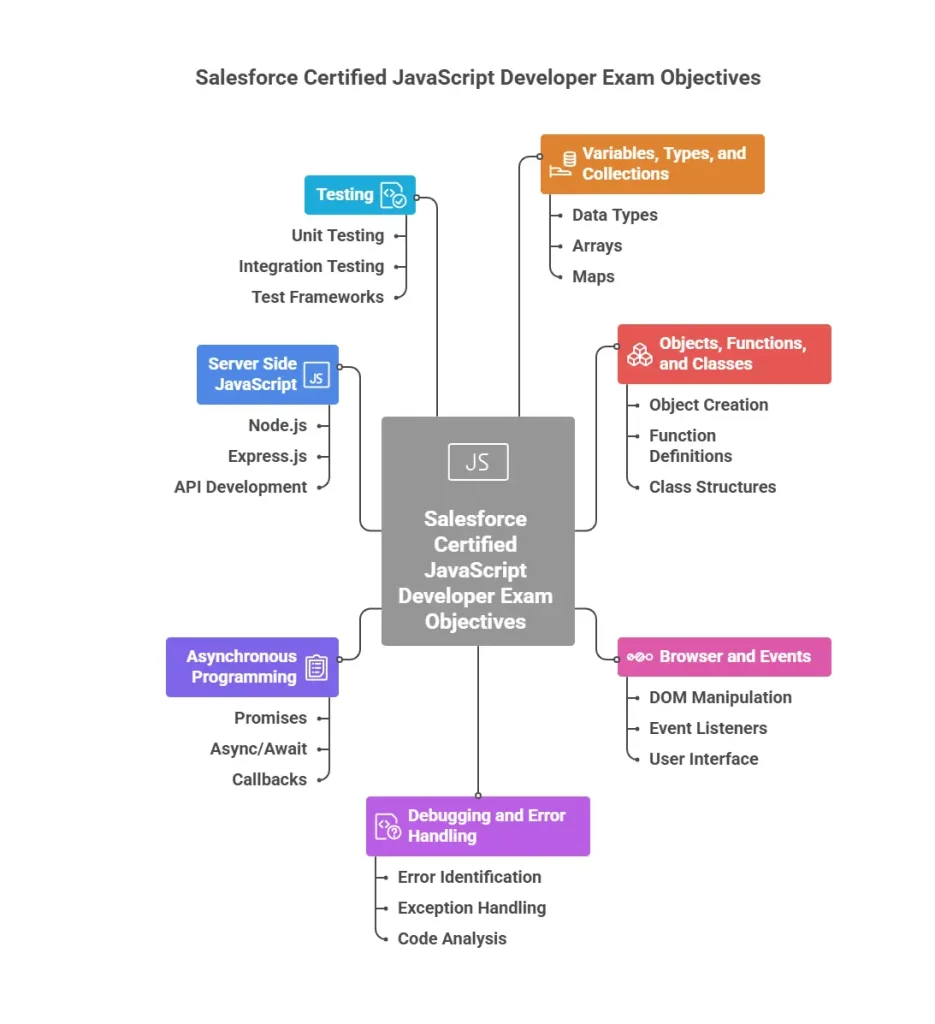
1. Variables, Types, and Collections (23%)
This is the highest-weighted domain, accounting for approximately 14 out of 60 questions. You must demonstrate mastery of variable declaration using var, let, and const, understanding their scoping rules and hoisting behavior. The exam tests type coercion—how JavaScript implicitly converts between types—and how to predict the results of comparisons involving different types. You need to understand truthy and falsy values, manipulate strings using methods like split, slice, and substring, work with dates and the Date object, and perform complex array operations using map, filter, reduce, forEach, and find. JSON parsing and stringification is also tested.
2. Objects, Functions, and Classes (25%)
This is the most heavily weighted domain. You must understand object creation using object literals and constructors, property access using dot and bracket notation, and prototypal inheritance. The exam tests function declarations versus function expressions, arrow functions and their lexical this binding, default parameters, rest parameters, and higher-order functions. You need to demonstrate knowledge of ES6 classes, constructors, methods, static methods, inheritance using extends, and super. Understanding JavaScript modules—how to export and import functions, classes, and variables—is critical. The exam also covers decorators and their use in extending function behavior.
3. Browser and Events (17%)
This domain tests your understanding of the Document Object Model (DOM) and how JavaScript interacts with web pages. You must know how to select elements using querySelector and querySelectorAll, manipulate element properties and attributes, handle events using addEventListener, understand event bubbling and capturing, and use preventDefault and stopPropagation. The exam covers browser-specific APIs like the Fetch API for making HTTP requests, the Geolocation API, the History API for navigation, and Web Storage API concepts (though you should know that Web Storage is not available in Lightning Web Components).
4. Debugging and Error Handling (7%)
You need to demonstrate proficiency with debugging techniques using console methods like console.log, console. error, console.table, and console.assert. The exam tests your understanding of the eight JavaScript error types: Error, SyntaxError, ReferenceError, TypeError, RangeError, URIError, EvalError, and InternalError. You must know how to implement try-catch-finally blocks for error handling, throw custom errors, and identify ineffective error handling that could cause applications to fail silently.
5. Asynchronous Programming (13%)
This domain covers asynchronous JavaScript patterns essential for modern development. You must understand the event loop, callback functions, Promises (including creation, chaining, and error handling with .then, .catch, and .finally), async/await syntax for cleaner asynchronous code, and how to handle errors in asynchronous operations. The exam tests your ability to identify when to use asynchronous patterns and how to avoid common pitfalls like callback hell.
6. Server Side JavaScript (8%)
This domain focuses on Node.js fundamentals. You need to identify appropriate Node.js implementations for given scenarios, understand Node.js core modules like fs (file system), http, path, and os, know how to use npm for package management, and understand the difference between require and import in Node.js. The exam tests your ability to recognize when server-side JavaScript is the appropriate solution.
7. Testing (7%)
You must demonstrate knowledge of unit testing principles, understand the difference between black-box testing (testing without knowledge of internal implementation) and white-box testing (testing with full knowledge of internal logic), identify test doubles like mocks, stubs, and spies, write effective unit tests that are isolated and repeatable, and identify ineffective test code. The exam references Jest, the testing framework used for Lightning Web Components, so familiarity with Jest syntax and best practices is valuable.
Your Strategic Study Plan for Success
Success on this certification requires mastering both the theoretical exam and the hands-on superbadge. Here is a phased approach that balances both requirements.
Phase 1: Foundation Building and Assessment (Weeks 1-2)
Begin by reviewing the official Salesforce JavaScript Developer I Exam Guide available on Trailhead. This document outlines all exam objectives and provides recommended study resources. Complete the Trailhead trail “Study for the Salesforce JavaScript Developer I Exam,” which includes three modules with interactive flashcards and scenario-based questions covering all exam domains.
Assess your current JavaScript knowledge honestly. If you are rusty on core JavaScript concepts, invest time in foundational learning. The “You Don’t Know JS” series by Kyle Simpson is highly recommended for deepening your understanding of JavaScript fundamentals like scope, closure, this binding, prototypes, and asynchronous programming. These books are available for free on GitHub.
Complete the Quick Start: Lightning Web Components module on Trailhead to set up your developer environment. Install Visual Studio Code, the Salesforce CLI, and configure your development tools. Create a Trailhead Playground and practice deploying your first Lightning Web Component.
Phase 2: Deep Dive into High-Weight Domains (Weeks 3-6)
Focus intensely on Variables, Types, and Collections (23%) and Objects, Functions, and Classes (25%). These two domains account for 48% of the exam—approximately 29 out of 60 questions. Mastering these domains is essential for passing.
For Variables, Types, and Collections, practice writing code that demonstrates your understanding of var, let, and const scoping, type coercion scenarios, and array manipulation methods. Create small coding exercises where you predict the output of code snippets involving type coercion, then verify your predictions in a browser console or Node.js REPL. Practice complex array operations like chaining map, filter, and reduce to transform data.
For Objects, Functions, and Classes, practice creating classes with constructors and methods, implementing inheritance, using arrow functions in various contexts, and understanding how this behaves differently in arrow functions versus regular functions. Write modules that export and import functionality, and practice using decorators (even though they are not commonly used in Lightning Web Components, the exam tests this concept).
Dedicate at least one hour daily to coding exercises. Use resources like JavaScript30 by Wes Bos (free video course with 30 vanilla JavaScript projects) or FreeCodeCamp’s JavaScript Algorithms and Data Structures curriculum for hands-on practice.
Phase 3: Master Remaining Domains and Practical Skills (Weeks 7-10)
Study Browser and Events (17%) by building small interactive web applications. Create projects that involve DOM manipulation, event handling, and fetch API calls. Practice writing event handlers that demonstrate your understanding of event bubbling, capturing, and delegation.
For Asynchronous Programming (13%), write code using Promises and async/await. Practice converting callback-based code to Promise-based code, then refactor to use async/await syntax. Understand common asynchronous patterns and how to handle errors in asynchronous workflows.
For Server Side JavaScript (8%), install Node.js and practice using core modules. Write simple Node.js scripts that read and write files using the fs module, create HTTP servers, and manage packages with npm. Understand the Node.js event loop and how it differs from the browser event loop.
For Debugging and Error Handling (7%) and Testing (7%), practice using console methods for debugging, implement try-catch-finally blocks, and write unit tests using Jest. Install Jest locally and practice writing tests for simple functions, then progress to testing more complex scenarios including asynchronous code.
Phase 4: Lightning Web Components Specialist Superbadge (Weeks 8-12, Can Be Done Concurrently)
The Lightning Web Components Specialist superbadge is a challenging, hands-on assessment that tests your ability to build a fully functional Lightning Web Components application. It consists of 16 coding challenges and 2 quizzes, with Trailhead estimating 14 hours to complete (though many candidates report it takes 20-30 hours).
Before starting the superbadge, complete the four prerequisite modules: Quick Start: Lightning Web Components, Lightning Web Components Basics, Lightning Web Components and Salesforce Data, and Work with Salesforce Data. These modules provide foundational knowledge of the LWC framework.
The superbadge scenario involves building a boat rental application with features like search filters, interactive maps, reviews, ratings, and responsive layouts. You will create multiple Lightning Web Components that communicate using Lightning Message Service, leverage Lightning Data Service to interact with Salesforce data, implement third-party JavaScript libraries, and build custom Apex controllers.
Read all requirements carefully before starting. The superbadge instructions are presented in narrative form, and key requirements are sometimes mentioned as single words rather than explicit bullet points. Many candidates fail challenges because they missed subtle requirements. Read the entire scenario twice before writing any code.
Use the provided code templates as starting points. The superbadge includes HTML, CSS, and JavaScript snippets that you should incorporate into your components. Do not deviate significantly from these templates unless the challenge explicitly requires it—the code checker expects specific implementations.
If you get stuck, use the Lightning Web Components Developer Guide as your primary reference. The Trailhead Challenge Support page for this superbadge contains FAQs and troubleshooting tips. If code checks fail despite your component working correctly, review naming conventions (case sensitivity matters), statement order, and whether you used exact variable names specified in the instructions.
Phase 5: Final Preparation and Mock Exams (Weeks 11-12)
Complete full-length practice exams from reputable providers like Focus on Force. These practice exams simulate the real exam format, question difficulty, and time constraints. Aim to score consistently above 70% on practice exams before scheduling your real exam.
Review the JavaScript Developer I Exam Guide one final time and create a checklist of all exam objectives. For any objective where you feel uncertain, revisit study materials and practice coding exercises until you feel confident.
Focus on improving your code-reading speed. The exam presents many code snippets that you must analyze quickly to identify syntax errors, predict output, or determine correct implementations. Practice reading code aloud, explaining what each line does, and predicting the result before running it.
Career and Salary Opportunities
The Salesforce Certified JavaScript Developer I credential positions you for strong career opportunities both within and outside the Salesforce ecosystem. JavaScript developers are in high demand across all industries, with over 11 million JavaScript developers worldwide and JavaScript used on close to 95% of all websites.
According to salary data from ZipRecruiter and Glassdoor, JavaScript Developers in the United States earn competitive salaries. The average annual salary for a JavaScript Developer ranges from $106,000 to $119,000, depending on the data source. ZipRecruiter reports an average of $106,583 per year, while Glassdoor reports $118,958 per year. The typical salary range spans from $66,000 (25th percentile) to $128,000 (75th percentile), with top earners making $146,000 to $159,000 annually.
Entry-level JavaScript Developers with less than one year of experience earn approximately $79,000 to $89,000 annually. Mid-level developers with 3-5 years of experience earn $96,000 to $106,000. Senior JavaScript Developers with over 8 years of experience command salaries of $118,000 to $126,000, with some positions exceeding $156,000 in high-cost markets like California, New York, and Alaska.
For Salesforce-specific roles, combining the JavaScript Developer I certification with other Salesforce credentials like Platform Developer I, Platform App Builder, or OmniStudio Developer significantly increases your market value. Lightning Web Component developers are essential for modern Salesforce implementations, and certified professionals can negotiate higher salaries due to their specialized skill set.
Job titles for certified professionals include:
- Lightning Web Component Developer
- Salesforce JavaScript Developer
- Front-End Developer (Salesforce)
- Salesforce UI/UX Developer
- Full-Stack Salesforce Developer
The demand for Lightning Web Component expertise continues to grow as more organizations modernize their Salesforce implementations and migrate from Aura Components to Lightning Web Components. This certification proves you possess the JavaScript fundamentals needed to excel in this evolving landscape.
Exam Logistics: Policies You Need to Know
Registration Process: As of July 21, 2025, all Salesforce certification exam registrations are handled through Pearson VUE’s Salesforce Exam Voucher Store. You can register for online proctored exams or onsite exams at Pearson VUE testing centers. Tiered partner discounts and Premier/Signature customer pricing remain available after account validation.
Retake Policy: If you do not pass on your first attempt, you can retake the exam for $100 USD. There is no mandatory waiting period between the first and second attempts. However, if you fail a second time, you must wait 14 days before scheduling a third attempt. You are allowed unlimited retake attempts, but each retake incurs the $100 fee.
Certification Validity: Unlike most Salesforce certifications, the JavaScript Developer I credential does not require annual maintenance modules. Once you pass both the exam and the Lightning Web Components Specialist superbadge, your certification is valid indefinitely. This makes it a lifetime credential that does not expire.
Exam Scheduling: Visit the Salesforce Certification page to access the exam registration portal. From there, you will be directed to Pearson VUE to schedule your exam. Choose online proctoring for flexibility or an onsite testing center for a traditional testing environment.
Superbadge Completion: The Lightning Web Components Specialist superbadge can be completed entirely on Trailhead using a free Trailhead Playground. There is no cost to complete the superbadge, and you can work on it at your own pace. You can complete the exam and superbadge in any order—both credentials automatically combine to award the full Salesforce Certified JavaScript Developer I certification.
Practical FAQs & Common Challenges
1. How much JavaScript experience is truly necessary before taking this exam?
The exam is designed for candidates with 1-2 years of JavaScript development experience. If you are a complete beginner, this exam will be extremely challenging. The questions assume intermediate knowledge and test your ability to analyze complex code snippets quickly. You need comfort reading JavaScript code, identifying syntax errors, predicting output, and understanding execution flow.
However, if you have experience with other programming languages and understand concepts like loops, conditionals, functions, and object-oriented programming, you can accelerate your JavaScript learning by dedicating 8-12 weeks to focused study. The key is hands-on practice—reading about JavaScript is insufficient. You must write code daily to internalize concepts.
2. Which exam domains do candidates find most challenging?
The most challenging domains are Objects, Functions, and Classes (25%) and Asynchronous Programming (13%). Objects, Functions, and Classes requires deep understanding of how this works in different contexts, how arrow functions differ from regular functions, prototypal inheritance, and ES6 class syntax. Many candidates struggle with scope and closure concepts, particularly when analyzing nested functions or callbacks.
Asynchronous Programming is difficult because it tests your understanding of the event loop, Promises, and async/await—concepts that are counterintuitive for developers accustomed to synchronous programming. The exam presents code snippets with asynchronous operations and asks you to predict the order of execution, which requires visualizing how the event loop processes tasks.
Testing (7%) is also challenging for candidates without prior testing experience. If you have never written unit tests, the concepts of mocks, stubs, spies, and test isolation will be unfamiliar. Invest time learning Jest and writing tests for your own code to build confidence.
3. Should I complete the exam or the superbadge first?
The order is your choice, but most candidates recommend completing the superbadge first. Building the Lightning Web Components application forces you to apply JavaScript concepts in practical scenarios, which reinforces the theoretical knowledge tested on the exam. You will practice DOM manipulation, event handling, asynchronous programming, and modular code organization—all heavily tested on the exam.
If you complete the superbadge first, you will approach the exam with practical coding experience that helps you analyze code snippets more effectively. Conversely, if you pass the exam first, you may struggle with the superbadge because theoretical knowledge does not always translate to practical coding skills.
However, if you are a strong JavaScript developer but have limited Lightning Web Components experience, passing the exam first might build confidence before tackling the superbadge.
4. How difficult is the Lightning Web Components Specialist superbadge compared to other superbadges?
The Lightning Web Components Specialist superbadge is one of the most difficult superbadges on Trailhead. It consists of 16 coding challenges (compared to 6-10 for most superbadges) and requires approximately 20-30 hours to complete, despite Trailhead’s 14-hour estimate. The challenges are tightly coupled, meaning earlier components serve as dependencies for later ones. If you make a mistake early, it can cascade through multiple challenges.
The superbadge code checker is strict. Your component may function perfectly from a business logic perspective, but the code check can still fail due to incorrect variable naming, improper statement order, or minor deviations from the expected implementation. Many candidates report frustration when their working components fail validation due to technicalities.
Read all instructions carefully, use the provided code templates exactly as specified, and test your components thoroughly before submitting for validation. If a code check fails, review variable names (case-sensitive), method signatures, and the order of operations in your code.
5. What is the best strategy for studying asynchronous programming concepts?
Asynchronous programming is abstract and difficult to visualize. The best strategy is hands-on practice combined with visualization tools. Start by writing callback-based code, then refactor it to use Promises. Practice chaining .then() calls and handling errors with .catch(). Once comfortable with Promises, refactor the same code to use async/await syntax.
Use tools like JavaScript Visualizer (available online) to watch how the event loop processes synchronous code, asynchronous callbacks, Promises, and microtasks. Seeing the call stack, callback queue, and microtask queue in action will deepen your understanding.
Write code that mixes synchronous and asynchronous operations, then predict the order of execution before running the code. For example, combine console.log statements with setTimeout, Promises, and async/await to see how JavaScript prioritizes tasks.
6. Can I pass this exam without Salesforce platform experience?
Yes. This is a platform-agnostic certification testing pure JavaScript knowledge. You do not need to know Apex, Visualforce, Salesforce administration, or any other Salesforce-specific technology. The exam focuses entirely on JavaScript fundamentals that apply to any web development context.
However, to complete the Lightning Web Components Specialist superbadge, you will need basic familiarity with the Salesforce platform. The superbadge assumes you understand Salesforce objects, records, and relationships. If you are completely new to Salesforce, complete introductory Trailhead modules like “Quick Start: Platform Development” before starting the superbadge.
7. How should I prepare for code-reading questions on the exam?
The exam is heavily code-reading focused. You will see many questions presenting code snippets and asking you to identify errors, predict output, or select the correct implementation. To prepare, practice reading code aloud and explaining what each line does before predicting the result.
Use browser developer tools or Node.js REPL to run small code snippets and verify your predictions. If your prediction was wrong, analyze why—did you misunderstand type coercion, scope, hoisting, or asynchronous execution? Identifying your weak points through practice is essential.
Study common JavaScript “gotchas” like var hoisting, falsy values (0, “”, null, undefined, NaN, false), the difference between == and ===, how this binding works, and closure. Many exam questions test these edge cases.
8. Is it worth investing time in Node.js for this exam, given it’s only 8% of the exam?
Yes, but keep it proportional. Server-side JavaScript accounts for approximately 5 out of 60 questions, so you do not need to become a Node.js expert. Focus on core concepts: understanding what Node.js is, knowing the most commonly used core modules (fs, http, path, os), understanding npm and package.json, and recognizing when server-side JavaScript is the appropriate solution.
Install Node.js and run simple scripts that read files, write files, and create HTTP servers. Understand the difference between require (CommonJS) and import (ES modules). Many exam questions test your ability to identify appropriate Node.js implementations for given scenarios rather than writing Node.js code from scratch.
9. How important are practice exams for passing this certification?
Practice exams are essential for success. They familiarize you with the question format, difficulty level, and time constraints. The JavaScript Developer I exam is 105 minutes for 60 questions (approximately 1 minute 45 seconds per question), which is tight given that many questions require analyzing complex code snippets.
Use practice exams from Focus on Force or other reputable providers to identify knowledge gaps. Take at least three full-length practice exams before scheduling your real exam, aiming to score consistently above 70%. Review every incorrect answer to understand why you were wrong and where your knowledge gaps exist.
Practice exams also improve your test-taking strategy. You will learn to eliminate obviously incorrect answers quickly, identify keyword clues in questions, and manage your time effectively.
10. What are the most common mistakes candidates make when attempting this certification?
The most common mistakes include:
Underestimating the exam difficulty: Many experienced developers assume their general programming knowledge will carry them through. This exam tests JavaScript-specific concepts like prototypal inheritance, hoisting, and the event loop that differ from other languages.
Neglecting hands-on practice: Reading about JavaScript concepts is insufficient. You must write code daily to internalize patterns and develop code-reading fluency.
Rushing through the superbadge: The Lightning Web Components Specialist superbadge is not a quick win. Allocate dedicated time (20-30 hours) and avoid trying to complete it in rushed evening sessions. The challenges require focus and attention to detail.
Ignoring the official exam guide: The Salesforce JavaScript Developer I Exam Guide lists all exam objectives. Some candidates skip objectives they find boring, then encounter questions on those topics during the exam. Study all objectives comprehensively.
Not practicing code reading: Many candidates can write JavaScript, but struggle to read and analyze code quickly. The exam rewards fast code-reading skills developed through deliberate practice.
Conclusion: Your Next Step
The Salesforce Certified JavaScript Developer I certification is a powerful credential that validates your core JavaScript competencies and positions you for success in modern web development and Salesforce Lightning development. By earning this certification, you demonstrate mastery of the JavaScript language, proficiency with Lightning Web Components, and the ability to build performant, maintainable, and reusable solutions.
Your journey to certification requires discipline, hands-on practice, and strategic focus on high-weight domains. Dedicate time to mastering Objects, Functions, and Classes (25%) and Variables, Types, and Collections (23%), as these domains account for nearly half the exam. Balance theoretical study with practical coding exercises, and complete the Lightning Web Components Specialist superbadge to solidify your understanding through real-world application.
Remember that this certification does not require annual maintenance modules. Once earned, it remains valid indefinitely—a testament to the enduring value of core JavaScript skills. Whether you are a web developer entering the Salesforce ecosystem or a Salesforce professional strengthening your programming foundation, this certification opens doors to high-demand roles building the next generation of Lightning applications.
Ready to get started? Visit the official Salesforce Certified JavaScript Developer I certification page to learn more and register for your exam. Your path to becoming a certified JavaScript developer starts today.
