
What Platform Data Architect Is All About
The Salesforce Platform Data Architect exam validates expertise in designing scalable, high-performing data solutions on the Salesforce Platform for enterprise data management. In 2026, it covers 6 weighted domains: Data Modeling/Database Design (25%), Salesforce Data Management (25%), Master Data Management (10%), Data Governance (10%), Large Data Volumes (10%), and Data Migration (10%). A passing score of 67% is required across 60 multiple-choice/multiple-select questions in 105 minutes. The exam costs $400 USD, with a retake fee of $200 USD. Pricing varies by country and is subject to change. A typical preparation window is 8-16 weeks, depending on your Salesforce experience. The recommended study path combines official Salesforce Trailhead learning modules, hands-on practice in Developer Orgs, and full-length practice exams focused on scenario-based questions. The certification requires annual maintenance via free Trailhead modules. This guide details official resources, exam logistics, strategic study approaches, and practical FAQs to answer the core question: How do I successfully pass this exam?
Introduction: What is the Salesforce Certified Platform Data Architect and Why Does It Matter?
The Salesforce Certified Platform Data Architect certification validates your ability to design enterprise-scale data solutions that are scalable, secure, and optimized for performance. This credential proves you can assess complex data environments, create effective data models, manage massive data volumes, implement governance frameworks, and guide organizations through critical data migrations.
In the rapidly evolving Salesforce ecosystem, data is the foundation of every successful CRM implementation. Organizations face mounting challenges: integrating data from multiple sources, maintaining data quality across systems, complying with regulations like GDPR, and ensuring their Salesforce org performs efficiently even with millions of records. The Platform Data Architect certification demonstrates you possess the architectural expertise to solve these problems.
This certification directly supports roles like Data Architect, Solution Architect, Technical Architect, and Enterprise Architect. It validates that you can translate business requirements into technical data solutions, communicate trade-offs to stakeholders, and design systems that will scale with organizational growth. For professionals aspiring to the prestigious Certified Technical Architect (CTA) credential, the Platform Data Architect certification is a critical stepping stone that demonstrates mastery of the data domain.
Quick Facts & Exam Details
| Detail | Information |
|---|---|
| Exam Name | Salesforce Certified Data Architecture and Management Designer (Platform Data Architect) |
| Exam Code | Data-Architect / Plat-Arch-201 |
| Provider | Salesforce |
| Prerequisites | None required, but recommended: 1-2 years Salesforce experience and 5-8 years in data-centric initiatives |
| Passing Score | 67% (approximately 40 correct answers out of 60 questions) |
| Exam Duration | 105 minutes |
| Question Types | Multiple-choice and multiple-select questions (scenario-based) |
| Number of Questions | 60 scored questions plus up to 5 unscored questions |
| Exam Cost | $400 USD plus applicable taxes. Note: Prices vary by country and are subject to change. Always confirm the final cost during the registration process. |
| Retake Fee | $200 USD plus applicable taxes |
| Delivery Options | Proctored exam at a testing center or online proctored environment |
| Reference Materials | No hard-copy or online materials may be referenced during the exam |
Is This Certification Right for You? (Target Audience)
This certification is designed for experienced Salesforce professionals who work at the intersection of business requirements and technical data solutions. Ask yourself these questions:
Do you regularly:
- Design data models that support complex business processes across multiple Salesforce clouds?
- Make architectural decisions about how to integrate data from external systems into Salesforce?
- Plan and execute large-scale data migrations involving millions of records?
- Advise stakeholders on data governance policies, master data management, and data quality initiatives?
- Troubleshoot performance issues in orgs with large data volumes?
Is your background aligned?
- 1-2 years of hands-on Salesforce experience (Administrator or Developer level)
- 5-8 years supporting or implementing data-centric solutions
- Strong understanding of data modeling concepts, database design, and ETL processes
- Experience with Salesforce objects, fields, relationships, and sharing models
- Familiarity with data migration tools like Data Loader and understanding of Bulk API
If you answered yes to most of these questions, you’re an ideal candidate. Typical job roles include Data Architect, Technical Architect, Solution Architect, and senior consultants responsible for designing enterprise Salesforce implementations.
Exam Blueprint: Skills You’ll Be Tested On
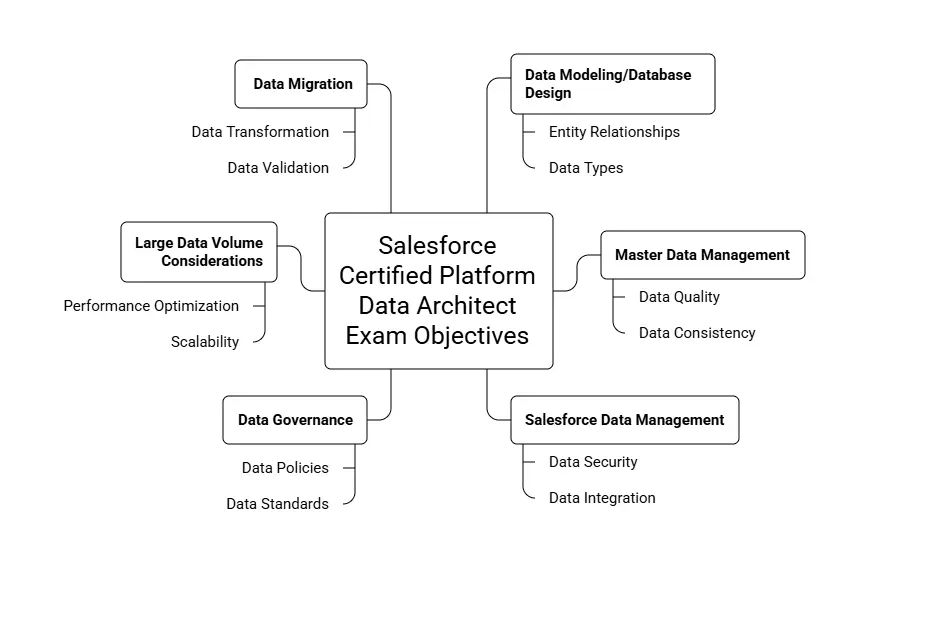
The exam evaluates your knowledge across six domains. Understanding these weightings is critical—focus your study time proportionally.
1. Data Modeling/Database Design (25%)
This domain tests your ability to design scalable, flexible data models using Salesforce objects, fields, and relationships. You’ll need to demonstrate expertise in choosing between standard and custom objects, master-detail versus lookup relationships, and understanding when to use Big Objects versus standard objects. Questions assess your ability to design models that support complex business processes while maintaining performance and adhering to Salesforce limits. You must understand how to capture and manage metadata, apply appropriate field-level security, and design schemas that scale to millions of records.
2. Salesforce Data Management (25%)
This is the other critical domain representing 25% of the exam. It focuses on data quality, governance, and lifecycle management. You’ll encounter scenarios requiring you to identify data quality issues (duplicates, incompleteness, accuracy problems) and recommend solutions using validation rules, duplicate management, and Data.com Clean. The domain covers designing GDPR-compliant data models, implementing data retention and archiving strategies, and establishing frameworks for data governance including roles, responsibilities, policies, and monitoring mechanisms.
3. Master Data Management (10%)
This domain evaluates your understanding of Master Data Management (MDM) principles and implementation approaches. You must demonstrate knowledge of establishing a “golden record” or “system of truth” across multiple data sources, implementing data survivorship rules, and consolidating data attributes from disparate systems. Questions test your ability to harmonize data, manage hierarchies, and apply canonical modeling techniques for enterprise-wide data consistency.
4. Data Governance (10%)
Data governance questions assess your ability to design and implement enterprise governance programs. This includes defining roles like data stewards and data custodians, establishing policies and standards, creating data classification schemes, and setting up monitoring and measurement frameworks. You’ll need to understand how to engage stakeholders in data stewardship, manage data ownership and accountability, and implement processes for ongoing data quality management.
5. Large Data Volumes (10%)
This domain focuses on performance optimization for orgs handling millions of records. You must understand indexing strategies, skinny tables, platform limits around data storage and API calls, and techniques for avoiding data skew. Questions cover designing solutions that maintain performance with large data volumes, managing sharing calculations efficiently, and understanding when record locking becomes an issue. Knowledge of query optimization and report performance tuning is essential.
6. Data Migration (10%)
Data migration questions test your ability to plan and execute complex data loads and extractions. You need expertise in using the Bulk API in parallel and serial modes, managing record locks during migrations, handling parent-child relationships, implementing deferred sharing calculations, and using external IDs to prevent duplicates. The domain covers techniques like PK Chunking for extracting massive datasets and strategies for optimal data migration performance.
Your Strategic Study Plan for Success
Success on this exam requires a methodical approach combining official learning resources, hands-on practice, and scenario-based preparation.
Phase 1: Foundation Building (Weeks 1-3)
Official Trailhead Learning Path Start with the Architect Journey: Data Architecture and Management Trailmix. This curated collection includes modules, projects, and best practice videos specifically designed for this certification. Budget approximately 24 hours to complete this trail thoroughly.
Study the Official Exam Guide Download and review the official exam guide PDF. This document outlines all 21 objectives across the 6 domains. Use it as your master checklist—every objective represents potential exam content.
Build Your Foundation If you’re not already Salesforce Administrator certified, review core concepts: object relationships, sharing and security models, validation rules, workflow automation, and report building. These fundamentals underpin every data architecture decision.
Phase 2: Deep Domain Mastery (Weeks 4-10)
Focus on the Heavy Hitters (50% of Exam) Dedicate significant time to Data Modeling/Database Design and Salesforce Data Management. For each objective within these domains:
- Study the theory through Trailhead modules and Salesforce documentation
- Build hands-on examples in a Developer Org or Trailhead Playground
- Document scenarios where each approach works best
Critical Topics for Hands-On Practice:
- Creating and comparing lookup vs. master-detail relationships
- Implementing Big Objects and understanding their limitations
- Building data quality rules using validation rules and duplicate management
- Configuring field-level security and object-level permissions
- Designing GDPR-compliant data models with data classification
- Implementing archiving strategies using the Bulk API and hard delete
- Testing data import/export scenarios with Data Loader and Bulk API in parallel mode
Master the Remaining Domains For Master Data Management, Data Governance, Large Data Volumes, and Data Migration:
- Focus on understanding the “why” behind architectural decisions
- Study Salesforce limits documentation (API limits, storage limits, query limits)
- Learn PK Chunking, skinny tables, and indexing strategies
- Understand when to recommend on-platform vs. off-platform archiving solutions
Phase 3: Scenario-Based Preparation (Weeks 11-14)
Practice Exams Are Essential. This exam is heavily scenario-based. You won’t just answer “what is X?”—you’ll answer “given this complex business scenario with these constraints, which architectural approach is best and why?”
Invest in quality practice exams from reputable sources like Focus on Force. Aim to consistently score 85% or higher before scheduling your exam. After each practice test:
- Review every incorrect answer thoroughly
- Understand why the correct answer is optimal
- Identify patterns in question types
- Document gaps in your knowledge for targeted review
Join Study Groups Engage with other candidates preparing for the exam. Discussing scenarios and comparing architectural approaches deepens understanding and exposes you to different perspectives.
Phase 4: Final Review (Weeks 15-16)
Create Quick Reference Sheets Build condensed notes on:
- When to use each type of relationship
- Comparison tables for Big Objects vs. Standard Objects
- Data migration decision trees (serial vs. parallel, deferred sharing)
- MDM implementation approaches
- GDPR compliance requirements
Simulate Exam Conditions Take full-length practice exams under timed conditions (105 minutes). Practice your time management—you have approximately 1.75 minutes per question.
Final Confidence Check The day before your exam, review the official exam guide one more time. Ensure you can speak confidently to every single objective. If any area feels weak, do a targeted review using Salesforce Help documentation.
Career and Salary Opportunities
The Salesforce Certified Platform Data Architect credential opens doors to senior-level roles with significant earning potential. Organizations across industries need professionals who can design robust data architectures that scale with business growth.
Target Job Roles:
- Salesforce Data Architect
- Salesforce Solution Architect (Data-focused)
- Enterprise Data Architect
- Salesforce Technical Architect
- Senior Salesforce Consultant specializing in data solutions
Salary Insights:
According to recent 2025 data from Glassdoor and ZipRecruiter, Salesforce Data Architects in the United States command strong compensation:
- Entry-Level Data Architects (1-3 years Salesforce experience): $85,000 – $100,000 annually
- Mid-Level Data Architects (3-7 years experience): $120,000 – $150,000 annually
- Senior Data Architects (7+ years experience): $150,000 – $200,000+ annually
- Principal/Lead Architects: $180,000 – $250,000+ annually
Glassdoor reports the average Data Architect base salary at Salesforce itself is approximately $187,000 per year, with total compensation packages (including stock and bonuses) ranging from $204,000 to $315,000.
Geographic location significantly impacts compensation. Major tech hubs like San Francisco, New York, Seattle, and Boston typically offer 20-30% higher salaries than the national average due to cost of living and competitive talent markets.
Career Trajectory: The Platform Data Architect certification positions you for advancement toward the Salesforce Certified System Architect or Application Architect credentials. Many professionals use this certification as part of their journey toward the prestigious Salesforce Certified Technical Architect (CTA) certification—the pinnacle of Salesforce credentials that commands salaries well into the $200,000+ range.
Exam Logistics: Policies You Need to Know
Scheduling Your Exam Register and schedule through Salesforce Webassessor. You can choose between testing at a physical Kryterion testing center or taking the exam online with remote proctoring.
Retake Policy If you don’t pass on your first attempt, the retake fee is $200 USD (50% of the original cost). You can attempt the exam up to three times per Salesforce release cycle. Salesforce releases updates three times annually (Spring, Summer, Winter), so timing matters if you need multiple attempts.
Certification Validity and Maintenance Your certification remains valid as long as you complete required maintenance. Salesforce requires annual maintenance through free Trailhead modules that cover new platform features and updates. Missing maintenance deadlines will cause your certification to become inactive, requiring you to retake the full exam.
Maintenance typically involves:
- Completing one Architect Maintenance Module per year (covers all architect certifications you hold)
- The module takes approximately 30-60 minutes
- Consists of reviewing release notes and passing a brief assessment
- Completely free—no fees required
Important: Link your Webassessor and Trailhead accounts to ensure your maintenance status displays correctly. Check your Trailblazer profile regularly for “Maintenance Due” notifications.
Practical FAQs & Common Challenges
1. How much hands-on experience is truly necessary before taking this exam?
Salesforce officially recommends 1-2 years of Salesforce platform experience and 5-8 years in data-centric roles. However, the quality of experience matters more than duration. You need real-world exposure to designing data models for complex business processes, executing data migrations, and troubleshooting performance issues in production orgs. If you’ve only worked with small Salesforce implementations with straightforward data models, you should gain more diverse experience before attempting this exam. Consider volunteering for projects involving data migrations, multi-org consolidations, or large data volume optimizations to broaden your practical knowledge.
2. Which exam domains or topics do candidates find most challenging?
The two areas that consistently challenge candidates are Large Data Volumes (LDV) and Master Data Management (MDM). LDV questions require understanding technical details like skinny tables, selective queries, data skew, and platform indexing that many candidates don’t encounter regularly unless they work with enterprise-scale implementations. MDM questions test theoretical knowledge about establishing golden records, data survivorship rules, and canonical modeling—concepts that require study even for experienced practitioners. Additionally, scenario-based questions about choosing optimal data migration strategies(serial vs. parallel Bulk API, deferred sharing, managing locks) trip up many test-takers because they require weighing multiple architectural trade-offs simultaneously.
3. Should I earn other certifications before attempting Platform Data Architect?
While there are no formal prerequisites, earning Salesforce Administrator and Platform App Builder certifications first is highly advisable. These foundational credentials ensure you thoroughly understand Salesforce objects, relationships, security models, and declarative capabilities—all essential knowledge for data architecture decisions. Many successful candidates also hold Platform Developer I certification, which helps with understanding API integration patterns and Apex data operations. If you’re targeting the Salesforce System Architect or Application Architect credentials, note that Platform Data Architect is one of four required prerequisites for both.
4. What’s the best strategy for performance-based scenario questions?
This exam doesn’t include traditional hands-on labs, but scenario questions function similarly—they present complex business requirements and ask you to select the optimal architectural approach. The key strategy is eliminating obviously incorrect answers first, then evaluating the remaining options based on scalability, maintainability, and alignment with Salesforce best practices. Always consider platform limits, performance implications at scale, and long-term maintainability. When choosing between solutions, favor approaches that use standard platform features over heavily customized solutions. Practice reading scenarios carefully to identify hidden requirements (like “must support 50 million records” or “data must remain accessible for 10 years”) that eliminate certain architectural choices.
5. How long should I realistically study for this exam?
Study duration varies significantly based on your current experience level. Candidates with 2+ years of active Salesforce data architecture work typically need 8-12 weeks of focused preparation, dedicating 10-15 hours per week to studying and hands-on practice. If you’re transitioning from an administrator or developer role into architecture, plan for 12-16 weeks with 15-20 hours weekly. Spreading your study over time is more effective than cramming—architectural concepts need time to solidify through repeated practice and real-world application. The hands-on practice component is non-negotiable; you cannot pass this exam through reading alone.
6. Is the 67% passing score considered difficult to achieve?
The 67% passing score (approximately 40 correct answers out of 60) might seem approachable, but this is an advanced certification with complex scenario-based questions. Each question typically presents multi-layered business requirements where you must evaluate trade-offs between multiple valid approaches to identify the best solution. The scenario complexity means that even experienced architects find questions challenging. Plan to consistently score 85%+ on practice exams before feeling confident for the real exam. The good news: once you’ve built deep domain knowledge through systematic study and hands-on practice, the passing score becomes achievable.
7. Should I focus more on practice exams or hands-on labs?
You need both, but prioritize them strategically. In the early phases (Weeks 1-8), emphasize hands-on practice in Developer Orgs to build fundamental understanding of how data modeling, relationships, sharing models, and migration tools actually work. In later phases (Weeks 9-14), shift focus toward practice exams to train your scenario-analysis skills and time management. The ideal ratio is approximately 60% hands-on experimentation and 40% practice exams. Hands-on work builds deep understanding; practice exams teach you how Salesforce frames questions and how to identify optimal solutions under time pressure.
8. What should I do if I fail on my first attempt?
First, don’t be discouraged—many successful architects don’t pass on their first try. Immediately after your exam (while memory is fresh), document every topic you found challenging. Salesforce provides a score report showing your performance by domain. Identify which domains fell below 70% and prioritize those areas in your re-study plan. Schedule your retake as soon as you feel prepared but within the same release cycle to avoid relearning updated content. Use the failed attempt as diagnostic information about your knowledge gaps rather than viewing it as a setback. Many candidates report that the learning from a first attempt makes the second attempt significantly easier.
Conclusion: Your Next Step
The Salesforce Certified Platform Data Architect certification represents a significant career milestone. It validates that you possess the architectural expertise to design enterprise-scale data solutions that drive business value. This certification opens doors to senior roles, higher compensation, and recognition as a trusted advisor who can navigate the most complex data challenges organizations face on the Salesforce platform.
Your path forward is clear: commit to systematic study, invest in hands-on practice, leverage quality preparation resources, and approach this exam with the seriousness it deserves. The 8-16 weeks of focused preparation will pay dividends throughout your career.
Ready to begin?
Visit the official Salesforce Data Architect certification page to access the complete exam guide, schedule your exam through Webassessor, and start your Trailhead learning journey today. Your future as a Salesforce Data Architect awaits.
