
Everything You Need to Know About Plat-Arch-205
The Salesforce Sharing and Visibility Architect certification validates your ability to design secure, scalable sharing and security models on the Salesforce platform. In 2026, the exam covers 4 domains: Permissions to Standard Objects, Custom Objects, and Fields (27%), Access to Records (39%), Access to Other Data (21%), and Implications of Security Model Choice (13%). A passing score of 67% is required across 60 scored questions (plus 5 unscored). The exam costs $400 USD, with a $200 retake fee. A typical preparation window is 6-12 weeks for experienced Salesforce professionals with 2-3 years of platform experience. The recommended study path combines official Salesforce Trailhead modules, hands-on practice in a Developer org, and comprehensive practice exams. The certification requires annual maintenance through free Trailhead modules released with each Salesforce update. This guide details official resources, exam logistics, strategic preparation, and answers to critical questions that candidates face when preparing for this advanced architect-level credential.
Introduction: What is the Salesforce Platform Sharing and Visibility Architect and Why Does It Matter?
The Salesforce Platform Sharing and Visibility Architect certification is an advanced credential designed for professionals who design and implement complex security and sharing models on the Salesforce platform. This certification validates your expertise in translating business security requirements into scalable, maintainable technical solutions.
This credential matters because data security and access control are the foundation of every Salesforce implementation. Organizations face increasingly complex requirements for who can see what data, under which conditions, and how access scales as their business grows. Architects with this certification demonstrate they can balance security, usability, and system performance while meeting regulatory and business requirements.
The certification proves you can architect solutions involving organization-wide defaults, role hierarchies, sharing rules, manual sharing, teams, programmatic sharing with Apex, and understand the performance implications of your security decisions. These skills are essential for roles including Technical Architect, Solution Architect, Advanced Administrator, and Senior Business Analyst positions within the Salesforce ecosystem.
Quick Facts & Exam Details
| Detail | Information |
|---|---|
| Exam Name | Salesforce Certified Platform Sharing and Visibility Architect (Plat-Arch-205) |
| Provider | Salesforce |
| Prerequisites | None officially required, but 2-3 years of Salesforce experience and 4-5 years managing sensitive data in enterprise environments strongly recommended |
| Passing Score | 67% (approximately 40 correct answers out of 60 scored questions) |
| Exam Duration | 120 minutes |
| Question Types | Multiple-choice and multiple-select questions, including scenario-based questions |
| Number of Questions | 60 scored questions + 5 unscored questions |
| Exam Cost | $400 USD. Note: Prices vary by country and are subject to change. Always confirm the final cost during the registration process, as local taxes may apply. |
| Retake Fee | $200 USD (50% of the original exam fee) |
| Delivery Options | Online proctored exam or in-person at a testing center via Webassessor |
| Language | English |
Is This Certification Right for You? (Target Audience)
This certification is designed for experienced Salesforce professionals who regularly work with security and sharing configurations. Ask yourself these questions:
- Do you have 2-3 years of hands-on experience with Salesforce, particularly with security features?
- Have you worked with enterprise data for 4-5 years, managing sensitive information and data policies?
- Do you currently design or implement sharing models that involve multiple layers of access control?
- Are you comfortable translating business security requirements into technical solutions?
- Can you explain the tradeoffs between different sharing approaches to both technical and non-technical stakeholders?
If you answered yes to most of these questions, you’re likely ready to pursue this certification. This credential is ideal for:
- Technical Architects who design enterprise-scale Salesforce solutions
- Solution Architects who translate business requirements into platform configurations
- Advanced Administrators who manage complex security models
- Senior Business Analysts who bridge the gap between business needs and technical implementation
The certification is a prerequisite for the Application Architect credential and is also required for the B2B Solution Architect certification path, making it valuable for anyone pursuing the Salesforce Technical Architect (CTA) credential.
Exam Blueprint: Skills You’ll Be Tested On
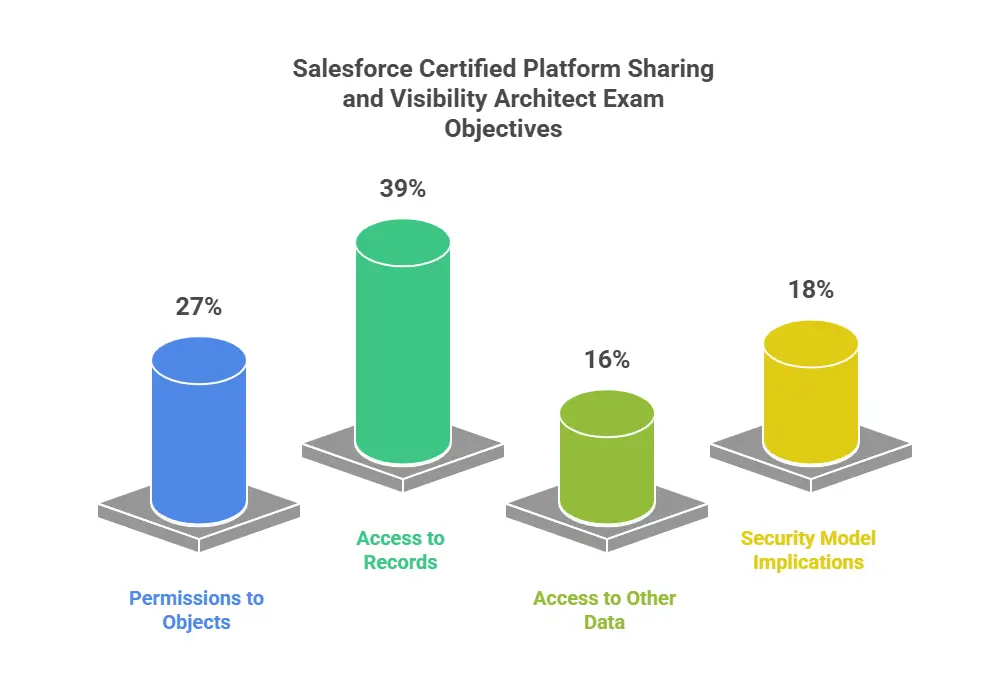
The exam is divided into four domains, each with specific weight and focus areas:
1. Permissions to Standard Objects, Custom Objects, and Fields (27%)
This domain tests your ability to design object-level and field-level security. You need to determine the appropriate permissions for different user groups while balancing security with usability. Key skills include recommending the correct object permissions (Read, Create, Edit, Delete), designing field-level security strategies, implementing data hiding at the UI level, and determining appropriate access controls for sensitive data like PCI, PII, or HIPAA-protected information. You must also understand how to enforce security programmatically and grant access to data that isn’t stored in standard or custom objects.
2. Access to Records (39%)
This is the heaviest-weighted section and the core of the exam. You’ll be tested on your ability to design record-level access using organization-wide defaults, role hierarchies, sharing rules, manual sharing, teams, and programmatic sharing. Critical topics include setting appropriate org-wide defaults to establish baseline access, leveraging role hierarchy to grant access up the chain, creating criteria-based and owner-based sharing rules, implementing account and opportunity teams, configuring sharing for external community users, understanding when Territory Management 2.0 applies, and knowing when declarative tools aren’t sufficient and Apex sharing is needed. You must also validate your sharing model through proper testing methodologies.
3. Access to Other Data (21%)
Not all data in Salesforce lives in standard or custom objects. This section covers access control for reports, dashboards, list views, folders, content, files, and other non-object data. You need to understand how to segment views and folders using groups and roles, configure report and dashboard visibility, manage Chatter and file sharing, and determine access controls for data in external systems, AppExchange packages, and other non-core platform features.
4. Implications of Security Model Choice (13%)
This domain assesses your understanding of how security decisions impact system performance and scalability. You must identify performance issues related to sharing recalculations, particularly with large data volumes, understand how apex sharing affects system performance, design security models that scale to thousands of users and millions of records, recognize license limitations that impact sharing solutions, and develop appropriate testing strategies to validate complex security models.
Your Strategic Study Plan for Success
Success on this exam requires a combination of theoretical knowledge, hands-on practice, and scenario-based thinking. Here’s a structured approach:
Phase 1: Foundation Building (Weeks 1-2)
Start by completing the official Trailhead learning path: “Architect Journey: Sharing and Visibility.” This curated Trailmix covers the fundamental concepts and takes approximately 26 hours. Focus on understanding the hierarchy of access control: org-wide defaults set the baseline, role hierarchy grants access upward, sharing rules extend access horizontally, and manual sharing handles exceptions.
Set up a Developer Edition org or use a Trailhead Playground. This hands-on environment is critical because you need to see how different configurations interact in real-time.
Phase 2: Domain Deep Dive (Weeks 3-6)
Work through each exam domain systematically. For each topic, follow this pattern: read the official Salesforce documentation, complete related Trailhead modules, build configurations in your Developer org, and test different scenarios to see what breaks and why.
For Object and Field Permissions: Configure profiles and permission sets. Practice scenarios where you need to grant read access but not edit access, or create access but not delete access. Understand the principle of least privilege.
For Record Access: This is your most important area. Build org-wide defaults at different levels (Private, Public Read Only, Public Read/Write). Create role hierarchies and observe how access flows. Build both criteria-based and owner-based sharing rules. Implement account teams and opportunity teams. Configure community user sharing for external users. Write basic Apex sharing code to understand when programmatic solutions are needed.
For Access to Other Data: Create report folders with different access levels. Build dashboards with dynamic visibility. Configure list views and understand their visibility options. Practice with Salesforce Content, Chatter groups, and file sharing.
For Performance and Scalability: Research large data volume considerations. Understand when sharing recalculations occur and how to minimize their impact. Learn about the “Grant Access Using Hierarchies” checkbox and when to disable it for performance.
Phase 3: Scenario Practice (Weeks 7-9)
This exam is heavily scenario-based. Practice translating business requirements into technical solutions. For example: “Sales reps should see all accounts in their territory, plus any account where they’re on the account team, but they shouldn’t see accounts from other territories unless explicitly shared.” Work through how you’d configure this using declarative tools first, then determine if programmatic solutions are needed.
Complete Superbadges, particularly the Security Specialist Superbadge, which provides complex, real-world scenarios that mirror exam questions.
Phase 4: Practice Exams and Review (Weeks 10-12)
Take full-length practice exams from reputable sources like Focus on Force. These practice tests help you identify weak areas and get comfortable with the question format. After each practice exam, thoroughly review every question you got wrong. Don’t just memorize the answer; understand why one solution is better than another.
Create summary notes or flashcards for topics you find challenging. Common difficult areas include the differences between “View All” and “Modify All” permissions, how implicit sharing works with parent-child relationships, and when to use apex managed sharing versus direct share object manipulation.
The week before your exam, focus on reviewing your weak areas and taking timed practice exams to build confidence.
Official Learning Resources
- Trailhead Learning Path: Architect Journey: Sharing and Visibility
- Official Exam Guide: Available on the Salesforce certification page
- Salesforce Help Documentation: Search for topics like “Sharing Settings,” “Org-Wide Defaults,” “Role Hierarchy,” and “Apex Sharing”
- Security Implementation Guide: Available in Salesforce Help
Career and Salary Opportunities
The Salesforce Platform Sharing and Visibility Architect certification opens doors to senior-level positions within the Salesforce ecosystem. The specialized knowledge it validates is in high demand as organizations require increasingly sophisticated security models.
Salary Expectations:
Based on data from Glassdoor and industry salary surveys, professionals with this certification typically earn between $120,000 and $150,000 annually in the United States, depending on experience, location, and additional certifications. Here’s how salaries break down by role:
- Technical Architect: $134,000 – $203,000 annually, with experienced architects (11-17 years) commanding premium salaries
- Solution Architect: $125,000 – $220,000 annually, particularly for those specializing in security and compliance
- Advanced Administrator/Manager: $110,000 – $140,000 annually
- Senior Business Analyst: $90,000 – $130,000 annually
Salaries vary significantly by location. Major tech hubs like San Francisco, New York, and Seattle typically offer20-30% higher compensation than the national average. Consulting firms like Accenture, Deloitte, and Slalom often pay at the higher end of these ranges.
This certification is part of the Application Architect credential pathway and is also required for the B2B Solution Architect certification, both of which lead to even higher earning potential. Professionals holding multiple architect certifications and progressing toward the Salesforce Certified Technical Architect (CTA) credential can command salaries exceeding $200,000 annually.
Beyond base salary, certified professionals often report receiving performance bonuses, profit sharing, and benefits packages that significantly enhance total compensation. According to industry surveys, earning this certification correlates with an average salary increase of 25-30% for those who were previously non-certified.
Exam Logistics: Policies You Need to Know
Scheduling Your Exam:
Register for the exam through Webassessor, Salesforce’s official exam registration platform. You can choose between an online proctored exam or an in-person exam at a testing center. Online proctoring offers flexibility but requires a quiet space, stable internet, and a computer with a webcam. Testing centers provide a controlled environment and can be helpful if you find fewer distractions in a formal setting.
Retake Policy:
If you don’t pass on your first attempt, you can retake the exam for $200 USD (50% of the original fee). Salesforce allows up to three exam attempts per release cycle. The retake policy is designed to encourage thorough preparation while giving candidates reasonable opportunities to demonstrate their knowledge.
Certification Validity and Maintenance:
Your certification remains valid as long as you complete the required maintenance modules. Salesforce releases three major updates annually (Winter, Spring, and Summer). For each release, you must complete a free maintenance module on Trailhead that covers new features and changes relevant to your certification.
You have approximately four months to complete each maintenance module. If you miss a maintenance deadline, your certification will expire or become suspended, requiring you to retake the full exam to reinstate it. Set calendar reminders as soon as you pass to ensure you never miss a maintenance window.
Additional Resources:
- Official Certification Page: Salesforce Certified Platform Sharing and Visibility Architect
- Exam Registration: Access through the Webassessor portal
- Maintenance Requirements: Track on your Trailhead profile under Credentials
Practical FAQs & Common Challenges
1. How much hands-on experience is truly necessary before taking this exam?
While Salesforce officially lists no prerequisites, realistically you need substantial practical experience. The recommended 2-3 years of Salesforce platform experience and 4-5 years managing enterprise data isn’t arbitrary. This exam tests your ability to architect solutions for complex, real-world scenarios. Without hands-on experience implementing sharing rules, troubleshooting access issues, and balancing security with usability, you’ll struggle with the scenario-based questions that dominate this exam. If you’re earlier in your Salesforce journey, focus first on the Administrator and Platform App Builder certifications to build foundational knowledge.
2. Which exam domains or topics do most candidates find the most challenging?
The “Access to Other Data” section consistently trips up candidates because it covers less commonly used features. Many architects focus heavily on object and record-level security but have limited experience with content delivery, community licenses, and non-object data access. Additionally, candidates often underestimate the performance and scalability questions. Understanding when sharing recalculations occur, how they impact system performance, and how to design for large data volumes requires specific experience that many professionals haven’t encountered. Focus extra study time on these areas, particularly community user license types and their sharing implications.
3. Should I take the Administrator or Platform App Builder certification before attempting this exam?
While not officially required, having these foundational certifications significantly helps. The Administrator certification covers basic security concepts like profiles, permission sets, and org-wide defaults. The Platform App Builder explores custom object relationships and how they affect data access. These fundamentals appear throughout the Sharing and Visibility Architect exam but at a much more advanced level. If you don’t hold these certifications, ensure you thoroughly understand their topics before attempting the architect exam. That said, if you have 3+ years of hands-on experience as an admin or developer, you may be ready without holding those specific credentials.
4. What is the best strategy for the scenario-based questions?
Scenario-based questions require you to analyze a business requirement and select the best technical solution from multiple potentially correct answers. The key word is “best” – often multiple options will work, but you need to choose the most scalable, maintainable, and appropriate solution. Read each scenario carefully, identify the key requirements and constraints, and mentally walk through how each answer option would be implemented. Consider factors like: Will this scale to thousands of users? Can this be maintained without custom code? What happens when the business requirement changes slightly? Practice this analytical approach during your study by building out scenarios in your Developer org and testing different solutions.
5. How long should I realistically study for this exam?
Study time varies dramatically based on your current experience level. If you’re an advanced administrator who regularly works with complex sharing models, 6-8 weeks of focused study might suffice. If you’re transitioning from a developer role and have limited security configuration experience, plan for 10-12 weeks. The key isn’t calendar time but rather depth of preparation: complete the Trailhead modules, build every configuration in a practice org, take multiple full-length practice exams, and score consistently above 80% before scheduling your exam. Some candidates pass after just 4 weeks of intensive preparation, while others need 4 months. Match your timeline to your confidence level, not an arbitrary schedule.
6. Is it better to focus more on practice exams or on hands-on labs?
You need both, but prioritize hands-on practice first. This exam tests your ability to architect solutions, not just memorize facts. Build sharing models in your Developer org. Create role hierarchies. Configure sharing rules. Break things and troubleshoot why they broke. This practical experience builds the intuition you need for scenario questions. Once you have solid hands-on experience, practice exams become incredibly valuable for identifying knowledge gaps, understanding question patterns, and building exam-taking confidence. A good rule of thumb: spend 70% of your study time on hands-on practice and official documentation, 30% on practice exams and review.
7. How important is understanding Apex sharing code for this exam?
You don’t need to be a developer to pass this exam, but you must understand when and why programmatic sharing is necessary. Know the difference between apex managed sharing and using the share object directly. Understand sharing reasons and how they integrate with declarative sharing. Be able to identify scenarios where declarative tools hit their limits and custom code is required. You should be able to read basic Apex sharing code and understand its purpose, even if you can’t write it from scratch. Several exam questions will present scenarios where declarative sharing isn’t sufficient, and you need to recognize that programmatic approaches are the answer.
8. What are some common mistakes candidates make that lead to failing this exam?
The most common mistake is memorizing concepts without understanding how they interact. For example, knowing that role hierarchy grants access is useless if you don’t understand how it interacts with org-wide defaults and sharing rules. Another frequent error is not reading questions carefully – many wrong answers are selected simply because candidates miss key words like “most,” “least,” “scalable,” or “maintainable.” Candidates also often underestimate the breadth of topics covered. The exam isn’t just about org-wide defaults and sharing rules; it covers community users, territory management, performance implications, testing strategies, and access to non-object data. Finally, some candidates schedule their exam before they’re truly ready, often after only completing Trailhead modules without sufficient hands-on practice or practice exam preparation.
Conclusion: Your Next Step
The Salesforce Certified Platform Sharing and Visibility Architect certification validates your expertise in one of the most critical aspects of the Salesforce platform: security and data access. This credential demonstrates you can design scalable, maintainable sharing models that meet complex business requirements while maintaining system performance.
Success requires more than memorization – it demands deep understanding of how security features interact, practical experience implementing complex sharing models, and the ability to analyze scenarios and choose optimal solutions. The investment of time and the $400 exam fee will return significant career dividends through higher salaries, expanded opportunities, and progression toward elite certifications like the Salesforce Technical Architect.
Start your journey today by visiting the official certification page, setting up your Developer org, and beginning the Architect Journey Trailmix. With dedicated preparation and hands-on practice, you’ll join the ranks of certified architects who design secure, scalable Salesforce solutions.
Ready to begin? Visit the official Salesforce Certified Platform Sharing and Visibility Architect page to access learning resources and schedule your exam.
