
Everything You Need to Know About SC-200
SC-200 is the Microsoft exam for the Microsoft Certified: Security Operations Analyst Associate certification. In 2026, it covers three domains: Mitigate threats using Microsoft 365 Defender (25–30%), Mitigate threats using Microsoft Defender for Cloud (20–25%), and Mitigate threats using Microsoft Sentinel (50–55%). A passing score of 700 on a scale of 100-1000 is required. Pricing is typically $165 USD but varies based on the exam’s proctoring location. A typical preparation window is 8–12 weeks, depending heavily on your background in security and Microsoft services. The recommended study path combines the official Microsoft learning materials with extensive, mandatory hands-on labs in a Microsoft 365 developer tenant, an Azure subscription, and full-length practice exams. The certification must be renewed annually via a free online assessment. This guide details official resources, including the study guide, scheduling pages, and exam policies.
Introduction: What is the SC-200 and Why Does It Matter?
In the world of cybersecurity, the Security Operations (SecOps) Analyst is the digital first responder. They are the professionals on the front lines, tasked with detecting, investigating, and responding to cyber threats. The Microsoft Certified: Security Operations Analyst Associate, earned by passing the SC-200 exam, is the industry-standard credential that proves you have the skills to excel in this critical role using Microsoft’s powerful security toolset.
This certification solves a crucial business problem: how to operationalize threat management. It’s not enough to just have security tools; you need skilled professionals who can use them to hunt for threats, triage alerts, and remediate attacks. The SC-200 validates your expertise in the three core pillars of Microsoft’s security operations: Microsoft 365 Defender, Microsoft Defender for Cloud, and Microsoft Sentinel. Earning this certification demonstrates to employers that you can be trusted to stand on the virtual wall, protecting their digital assets from an ever-evolving landscape of threats.
Quick Facts & Exam Details
| Detail | Information |
| Exam Name | SC-200: Microsoft Security Operations Analyst |
| Provider | Microsoft |
| Prerequisites | None. However, candidates are expected to have a strong foundational understanding of Microsoft 365, Azure, and core cybersecurity principles. |
| Passing Score | 700 on a scale of 100-1000. |
| Exam Duration | Approximately 120 minutes. |
| Question Types | Multiple-choice, multi-select, case studies, and complex scenario-based questions. |
| Exam Cost | $165 USD. Note: Prices vary by country and are subject to change. Always confirm the final cost during the registration process. |
Is This Certification Right for You? (Target Audience)
The SC-200 is designed for IT professionals who are ready to take on a hands-on role in a Security Operations Center (SOC). You are the ideal candidate if your role involves:
- Monitoring your organization’s IT environment for security threats.
- Investigating and responding to security alerts and incidents.
- Proactively hunting for malicious activity.
- Working with threat intelligence to understand and mitigate emerging risks.
If you are an IT Administrator with a passion for security, a junior cybersecurity professional, or anyone who wants to become a SOC Analyst, the SC-200 is designed to validate your skills.
Exam Blueprint: Skills You’ll Be Tested On
The SC-200 exam tests your practical ability to use Microsoft’s security tools to mitigate threats. Always check the official Microsoft exam page for the latest skills outline.
This domain is about setting up and maintaining the tools of the trade. It focuses on configuring your Microsoft Sentinel workspace, which is the heart of Microsoft’s security operations. You’ll need to know how to connect various data sources (like Microsoft Entra ID, Defender products, and firewalls) to Sentinel. It also covers managing permissions and roles for the security team within the platform to ensure everyone has the right level of access.
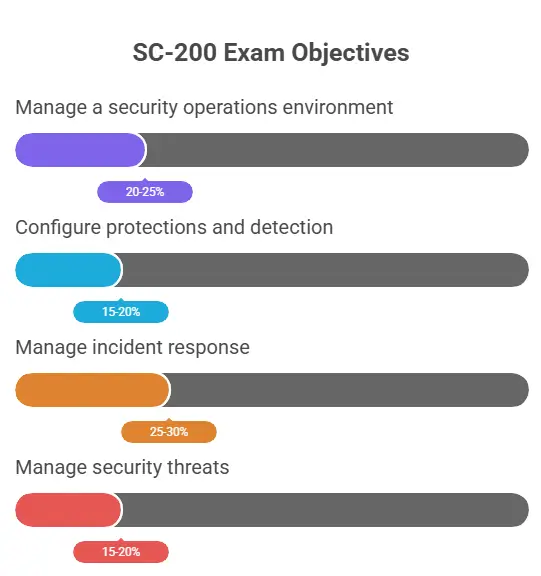
This section is about being proactive and setting up your defenses. It covers the configuration of the various Microsoft Defender services, such as Defender for Endpoint (for devices), Defender for Office 365 (for email and collaboration), and Defender for Identity (for on-premises identity). A major part of this domain is creating custom analytic rules in Microsoft Sentinel to detect specific, suspicious activities that might indicate an attack.
This is the largest and most critical domain, focusing on what to do when an alert is triggered. It covers the entire incident lifecycle within Microsoft Sentinel and Microsoft Defender XDR. You’ll need to know how to investigate alerts, triage incidents based on severity, and use the Kusto Query Language (KQL) to perform deep analysis of security data. It also includes using automation playbooks (SOAR) to respond to common threats automatically.
This domain is about actively hunting for threats that may have slipped past your automated defenses. It involves performing proactive threat hunting by writing custom KQL queries to search for patterns of suspicious behavior. You’ll also need to know how to use Microsoft Defender Threat Intelligence to understand the latest attacker tactics, techniques, and procedures (TTPs) to guide your hunts and strengthen your organization’s security posture.
Your Strategic Study Plan for Success
Success on the SC-200 is impossible without extensive, hands-on experience in the Microsoft security portals. This is a practical exam for a hands-on role.
- Phase 1: Build the Foundation (Weeks 1-2)
- Get Your Lab Environments: This is non-negotiable. You need two things:
- A Microsoft 365 Developer Program account for a free, renewable E5 tenant. This gives you access to the full Microsoft 365 Defender suite.
- A free Azure account to deploy a Microsoft Sentinel workspace and practice with Defender for Cloud.
- Start with Microsoft Learn: Your primary resource is the official SC-200 learning path on Microsoft Learn. This free, structured content is designed by Microsoft and aligns directly with every exam objective.
- Get Your Lab Environments: This is non-negotiable. You need two things:
- Phase 2: Deep Dive with Mandatory Labs (Weeks 3-9)
- Live in the Security Portals: As you complete a module in Microsoft Learn, immediately open your lab environments and perform the tasks. Don’t just read about Sentinel analytics rules; create one. Don’t just read about Defender for Endpoint; onboard a VM and simulate an attack.
- Master Kusto Query Language (KQL): The Sentinel portion of the exam heavily relies on your ability to read and understand KQL. Use the demo environment in Sentinel and work through the “must-learn-kql” series online. Practice writing queries to hunt for threats.
- Connect the Dots: The key to this exam is understanding how the tools work together. Ingest alerts from Microsoft 365 Defender into Microsoft Sentinel. Create a Sentinel playbook (a Logic App) that isolates a machine using the Defender for Endpoint connector.
- Phase 3: Final Prep with Practice Exams (Weeks 10-12)
- Use High-Quality Practice Tests: Take the Microsoft Practice Test for SC-200. This will familiarize you with the complex, scenario-based questions that test your investigation and decision-making skills.
- Analyze and Remediate: For every question you get wrong, go back to your lab and the documentation. The goal is to understand why a particular KQL query or response action was the correct solution.
- Review the Exam Guide: In the final week, reread the official skills outline to ensure you are confident in every topic, especially the heavily weighted Sentinel domain.
Career and Salary Opportunities
The Security Operations Analyst is one of the most critical and in-demand roles in all of technology.
- Market Demand: With the constant rise in cyber threats, every organization needs skilled defenders. The SC-200 certification makes you a prime candidate for roles like SOC Analyst, Cybersecurity Analyst, and Threat Hunter.
- Salary Expectations: A certification that validates these in-demand security skills leads to a very competitive salary.
- According to ZipRecruiter, the average annual salary for a Security Operations Analyst in the United States is approximately 101,657, with the majority of salaries ranging between $79,000 and $122,000.
- Glassdoor reports the estimated total pay for a SOC Analyst is around $96,013 per year.
Exam Logistics: Policies You Need to Know
- Retake Policy: If you do not pass on your first attempt, you must wait 24 hours before retaking it. For all subsequent attempts, a 14-day waiting period is imposed. You may not take the same exam more than five times in a 12-month period.
- Certification Validity: The Microsoft Certified: Security Operations Analyst Associate certification is valid for one year.
- Renewal Process: You must renew your certification annually by passing a free, online, unproctored renewal assessment on Microsoft Learn. This assessment is shorter and focuses on recent updates to the technology.
- Scheduling: You can schedule your exam to be taken at a testing center or online via the official Microsoft certification website.
Practical FAQs & Common Challenges
- How much hands-on experience is truly necessary before taking this exam?
A significant amount is required. This is not a theoretical exam. You must have practical, hands-on experience in the Microsoft Sentinel and Defender portals. You need to have investigated alerts, written KQL queries, and configured analytics rules. The questions are scenario-based and test your ability to apply knowledge. - How proficient do I need to be with Kusto Query Language (KQL)?
You need to be very comfortable reading and interpreting KQL. The Microsoft Sentinel domain is over 50% of the exam, and KQL is its language. You will be shown queries and asked what they do, or be given a goal and asked to choose the correct query. You don’t need to be a KQL guru who can write complex queries from memory, but you must understand the syntax of core commands like where, summarize, join, and project. - Should I take the SC-900 (Security Fundamentals) before attempting this one?
It is highly recommended. While not an official prerequisite, the SC-900 provides the essential vocabulary and a broad overview of the entire Microsoft security, compliance, and identity ecosystem. Having that baseline knowledge makes the deep, technical topics in the SC-200 much easier to understand and place in context. - What’s the difference between Microsoft Sentinel and Microsoft 365 Defender?
This is a critical concept for the exam. Microsoft 365 Defender is an XDR (Extended Detection and Response) tool. It automatically correlates alerts from across the M365 ecosystem (endpoints, identity, email) into a single incident. Microsoft Sentinel is a SIEM (Security Information and Event Management) and SOAR (Security Orchestration, Automation, and Response) tool. It can ingest data from everything—Microsoft services, third-party firewalls, Linux servers, etc.—to provide a single pane of glass for security operations. - How long should I realistically study for this exam?
For a candidate with a solid background in IT administration and security concepts, a study period of 8-12 weeks of focused preparation is a realistic timeline. The hands-on lab work and learning KQL will consume a significant portion of this time. - What are the official prerequisites for this certification?
There are no official, mandatory prerequisites. However, the exam assumes you have experience with Azure and Microsoft 365 and a strong understanding of core cybersecurity principles. - Is it better to focus on practice exams or on hands-on labs?
For the SC-200, hands-on labs are more critical, especially for mastering Sentinel and KQL. Your primary focus should be on building and testing configurations in your lab environments. Use practice exams in the final phase of your preparation to validate the knowledge you gained in the lab, identify your weak areas, and master your test-taking strategy for the scenario-based questions.
Conclusion: Your Next Step
The SC-200 certification is a powerful credential that proves you have the in-demand, hands-on skills to be a modern cyber defender. In an age where threats are constant and sophisticated, your expertise is more valuable than ever. The path requires a deep commitment to hands-on learning, especially with Microsoft Sentinel and KQL, but the career it will build is at the very heart of cybersecurity. Your journey to becoming a certified Security Operations Analyst starts now. Take the first step by visiting the official Exam SC-200 page on Microsoft Learn to review the skills outline and begin your journey through the official learning path.
