

ITIL 4 Exam Briefing
The ITIL 4 Strategist: Direct, Plan and Improve exam is administered by PeopleCert. In 2026, this universal module covers seven core learning domains: understanding key concepts of DPI including value, outcomes, costs and risks; mastering direction and planning methods; applying governance, risk management and compliance principles; implementing continual improvement models; leveraging communication and organizational change management; utilizing measurement and reporting methods; and directing, planning and improving value streams and practices. A passing score of 70% is required (28 out of 40 multiple-choice questions correct). The exam runs for 90 minutes in a closed-book format. Pricing starts at $839 USD for exam-only purchase or $1,299-$1,599 USD for eLearning packages. Note that prices vary by country and are subject to change. A typical preparation window is 3-5 weeks for candidates with ITIL 4 Foundation knowledge and management experience. This universal module is mandatory for both ITIL 4 Managing Professional and Strategic Leader designations. The certification must be renewed every three years via CPD points. This guide details official resources, exam policies, and practical strategies for success.
Introduction: What is the ITIL 4 Strategist: Direct, Plan and Improve and Why Does It Matter?
The ITIL 4 Strategist: Direct, Plan and Improve certification sits at the strategic core of the ITIL 4 framework. This universal module, mandatory for both Managing Professional and Strategic Leader designations, validates your ability to create a learning and improving IT organization with strong, effective strategic direction.
Unlike specialized ITIL modules that focus on specific domains like service delivery or stakeholder value, DPI addresses the fundamental leadership capabilities every IT professional needs, regardless of their specific role. Everyone in IT has the authority to direct, even if limited to personal decisions. Everyone should plan their work. And critically, everyone should contribute to, or actively lead, continuous improvement.
This certification proves you can establish strategic direction aligned with organizational objectives, develop tactical and operational plans that translate strategy into action, implement effective governance structures, manage risks intelligently, and most importantly, embed continual improvement into organizational DNA. These are not theoretical concepts, they’re practical methods you’ll apply immediately to create measurable value.
The module is particularly crucial in today’s environment, where digital transformation, agile methodologies, and DevOps practices demand unprecedented organizational agility. Organizations no longer succeed through rigid, hierarchical planning. They thrive by empowering teams to direct their work, plan iteratively, and improve continuously based on feedback and data. This certification validates your mastery of those modern approaches within the ITIL framework.
For IT professionals aspiring to management roles, this certification demonstrates leadership readiness. For those already in management, it provides the structured methodology needed to lead effectively. The skills you’ll develop, strategic thinking, continual improvement, leadership, change management, and value stream optimization, apply universally across IT service management and beyond.
Quick Facts & Exam Details
| Detail | Information |
|---|---|
| Exam Name | ITIL 4 Strategist: Direct, Plan, and Improve |
| Provider | PeopleCert |
| Prerequisites | ITIL 4 Foundation OR ITIL v3 Foundation (or higher) OR ITIL 4 Managing Professional Transition certificate. Accredited training is mandatory. |
| Passing Score | 70% (28 out of 40 questions correct) |
| Exam Duration | 90 minutes (plus 22.5 minutes additional time for non-native English speakers) |
| Question Types | Multiple-choice questions (40 questions total) |
| Exam Format | Closed book, online proctored exam available 24/7 |
| Exam Cost | $839 USD (exam only), $1,299 USD (eLearning), $1,599 USD (eLearning+). Note: Prices vary by country and are subject to change. Always confirm the final cost during the registration process. |
| Exam Code | ITIL-4-DPI |
| Take2 Benefit | One free exam resit included with eLearning+ package only ($1,599) |
| Certification Validity | Three years (renewable) |
| Available Languages | English, Chinese, French, German, Italian, Japanese, Polish, Portuguese (Brazil), Spanish |
Is This Certification Right for You? (Target Audience)
This certification targets IT professionals at all management levels who shape direction, strategy, or team improvement. Consider these questions:
- Are you responsible for translating organizational strategy into operational plans?
- Do you lead teams through change initiatives or improvement programs?
- Are you accountable for IT service performance and continual enhancement?
- Do you need structured methods for direction-setting, planning, and driving improvement?
If these scenarios describe your role or aspirations, this certification provides essential capabilities. The official guidance identifies ideal candidates as managers of all levels involved in shaping direction and strategy, practitioners developing continually improving teams, IT leaders establishing learning organizations, professionals responsible for governance and risk management, and anyone tasked with translating strategic vision into tactical execution.
Importantly, this is a universal module, it applies regardless of your specific IT specialization. Whether you work in service operations, development, infrastructure, security, or any other IT domain, the principles of direction, planning, and improvement are fundamentally relevant. The methods you’ll master work equally well for improving service desk operations, optimizing development workflows, or planning infrastructure transformations.
The certification particularly benefits those pursuing either ITIL 4 Managing Professional or Strategic Leader designations, as DPI is mandatory for both paths. If you hold or are pursuing ITIL 4 Foundation and want to advance your ITIL credentials, this module represents your next strategic step toward either designation.
Exam Blueprint: Skills You’ll Be Tested On
The ITIL 4 Strategist: Direct, Plan and Improve exam assesses your capability across seven core learning domains. Each represents essential competencies for strategic IT leadership:
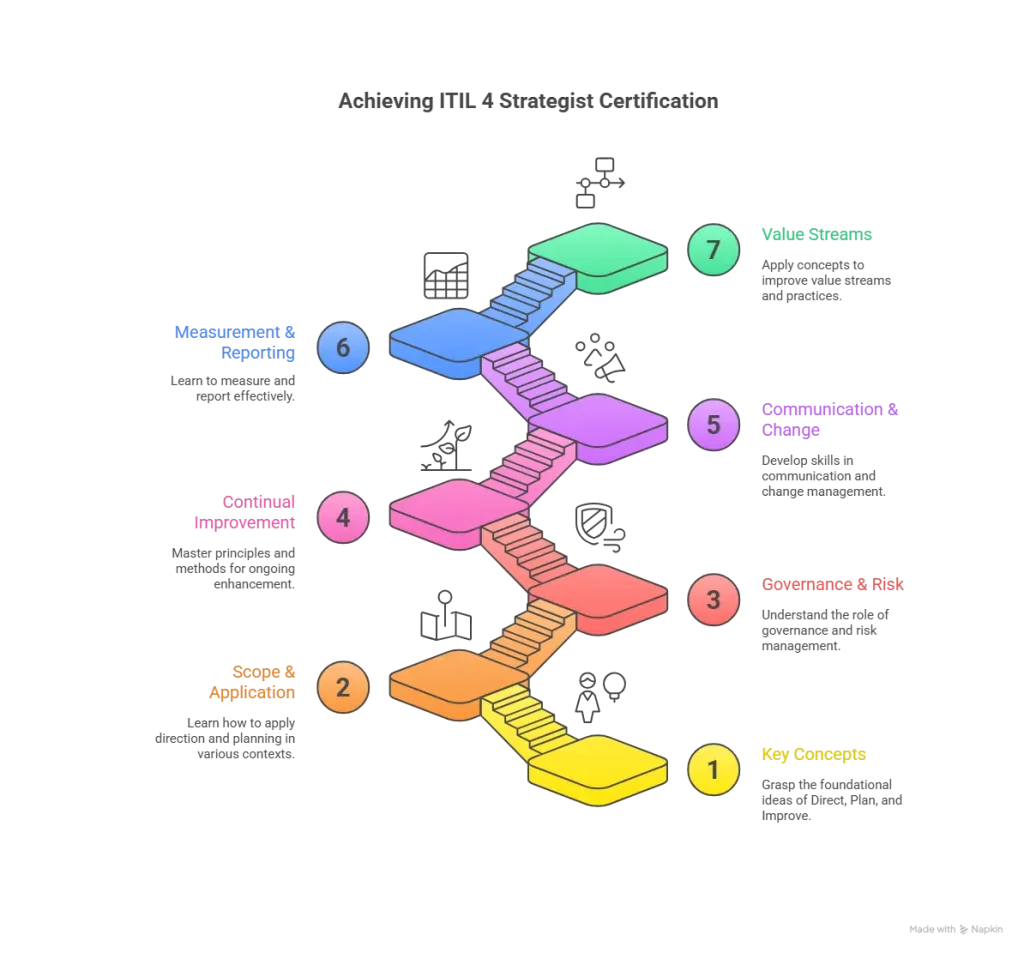
1. Understanding Key Concepts of Direct, Plan and Improve
You’ll demonstrate knowledge of fundamental DPI concepts including how value, outcomes, costs, and risks interact in strategic decision-making. This includes understanding the relationship between vision, mission, strategy, and tactics, and how these cascade through organizations. You’ll explain how the seven ITIL guiding principles inform direction, planning, and improvement activities.
2. Understanding the Scope and Application of Direction and Planning
This domain covers accurately assessing what needs to be directed and planned at different organizational levels. You’ll demonstrate knowledge of key direction and planning principles including analyzing strategic context, developing objectives aligned with organizational goals, creating actionable plans, and ensuring alignment between strategic, tactical, and operational planning levels.
3. Governance, Risk Management, and Compliance
You’ll show competency in establishing effective governance structures appropriate to organizational context. This includes understanding governance models, control frameworks, and decision rights allocation. You’ll demonstrate knowledge of IT service risk management principles, risk identification and assessment methods, and how to integrate governance, risk, and compliance into the ITIL Service Value System.
4. Continual Improvement Principles and Methods
This critically important domain assesses your understanding of the ITIL Continual Improvement Model and how to apply it at different levels, strategic, tactical, and operational. You’ll need to know how to identify improvement opportunities, prioritize them based on value and feasibility, build business cases for improvements, and implement improvement initiatives. You’ll demonstrate knowledge of various improvement approaches including Agile, Lean, and DevOps methodologies.
5. Communication and Organizational Change Management
You’ll demonstrate understanding of how effective communication supports direction, planning, and improvement. This includes stakeholder communication strategies, communication planning, and feedback mechanisms. You’ll show knowledge of organizational change management principles, understanding that improvements fail without proper change management. This covers change readiness assessment, resistance management, and sustaining change.
6. Measurement and Reporting Methods
This domain covers defining, selecting, and using Key Performance Indicators (KPIs) and metrics to assess IT service performance and effectiveness. You’ll need to understand different types of metrics (operational, tactical, strategic), how to establish measurement frameworks, create meaningful reports for different audiences, and use measurement data to drive improvement decisions.
7. Directing, Planning, and Improving Value Streams and Practices
You’ll demonstrate ability to understand differences between value streams and practices and how those differences impact direction, planning, and improvement approaches. This includes knowing how to select and use appropriate methods like value stream mapping to identify improvement opportunities, how to apply DPI principles to optimize value streams, and how to integrate the Four Dimensions of Service Management into direction, planning, and improvement activities.
Your Strategic Study Plan for Success
Phase 1: Foundation Review and Prerequisites (3-5 days)
Before beginning your DPI journey, ensure your ITIL 4 Foundation knowledge is solid. Review the Service Value System, Service Value Chain, Four Dimensions of Service Management, and the seven guiding principles. DPI builds extensively on these foundational concepts. If your Foundation certification is more than a year old, dedicate time to refreshing this knowledge, it provides essential context for DPI concepts.
Pay particular attention to the Continual Improvement practice fromthe Foundation, as DPI significantly expands this concept. Review the relationship between practices, value streams, and the Service Value Chain, as DPI requires a deep understanding of how these elements interact.
Phase 2: Accredited Training (3-5 days)
Attendance at accredited training is mandatory and non-negotiable for exam eligibility. Choose between instructor-led training (typically 3 days intensive) or official eLearning (8-10 hours of self-paced content). Both formats cover identical content and equally prepare you for the exam.
During training, focus intensely on understanding concepts rather than memorizing. The exam tests application and analysis, not recall. Engage fully with case studies and exercises, which demonstrate how DPI principles apply to real scenarios. Take comprehensive notes on frameworks and models: the Continual Improvement Model, value stream mapping process, governance structures, change management approaches, and measurement frameworks.
If choosing instructor-led training, ask questions liberally. Instructors can clarify nuances that reading alone might miss. If choosing eLearning, don’t rush through modules. Take time to complete knowledge checks and practical exercises fully, these reveal gaps in understanding before the exam.
Phase 3: Deep Study with Official Materials (2 weeks)
After training, immerse yourself in the official ITIL 4 Leader: Direct, Plan and Improve publication (included with exam purchase). This comprehensive text explores all exam domains in depth. Don’t simply read, study actively. For each major concept:
- Summarize it in your own words
- Identify how it relates to other DPI concepts
- Consider how you’d apply it in your organization
- Note any unclear areas for further research
Create visual maps showing relationships between concepts. For example, map how the Continual Improvement Model integrates with governance frameworks and change management. Map how strategic direction flows through tactical planning to operational execution. These visual representations deepen understanding beyond what text alone provides.
Focus particularly on:
- The seven-step Continual Improvement Model and how each step applies
- Value stream mapping methodology and notation
- Governance principles and organizational structures
- The relationship between direction, planning, and improvement
- How measurement and reporting support improvement decisions
- Change management stages and interventions
Review your training materials, especially any case studies or scenario analyses. Understanding how concepts apply in complex, realistic situations is crucial for exam success.
Phase 4: Practice and Application (1 week)
Take the PeopleCert official mock exam under timed, exam-like conditions. This is the single best predictor of exam readiness. The official mock exam closely replicates the style, difficulty, and timing of real exam questions. Analyze your results thoroughly, not just which questions you missed, but why certain answers were correct and others weren’t.
If possible, apply DPI concepts to your actual work. Identify a real improvement opportunity and work through the Continuous Improvement Model steps. Map a value stream from your organization. Analyze how your organization currently approaches direction, planning, and improvement and identify where DPI methods could enhance effectiveness.
Review the Quick Reference Guide from your training materials for rapid concept reinforcement. Create summary notes of key frameworks, models, and their application contexts. Practice explaining DPI concepts to colleagues, teaching forces clarity of understanding.
Phase 5: Final Review and Exam (2-3 days before exam)
In your final days, avoid learning new material. Instead, reinforce what you know. Review your summary notes, flashcards, and visual maps. Take a second mock exam if available (PeopleCert offers multiple versions). Focus on areas where your first mock exam revealed weaknesses.
Ensure you understand not just individual concepts but their relationships. Exam questions often require synthesizing knowledge from multiple domains. For example, a question might present an improvement scenario requiring you to apply both change management and measurement principles.
The day before your exam, do a light review only. Get adequate rest. Arrive at your exam mentally fresh, not exhausted from last-minute cramming.
Recommended Study Schedule:
- Days 1-3: Foundation review
- Days 4-6: Accredited training
- Days 7-20: Deep study with official publication
- Days 21-27: Practice exams and concept application
- Days 28-29: Final review
- Day 30: Exam day
Adjust timing based on your learning pace and existing knowledge, but maintain the phase sequence for optimal preparation.
Official Learning Resources
Required Resources:
- Accredited Training Course: Absolutely mandatory for exam eligibility. Available as instructor-led (3 days) or official eLearning (8-10 hours) from PeopleCert-accredited organizations. Proof of completion required before exam scheduling.
- Official ITIL 4 Strategist: Direct, Plan and Improve eBook: Included with exam voucher purchase. Your primary detailed reference covering all exam domains comprehensively.
- Learning Resource Kit: Includes comprehensive Learner Workbook and Quick Reference Guide, provided with exam purchase. The Quick Reference Guide becomes invaluable for rapid review.
Recommended Supplementary Resources:
- PeopleCert Official eLearning: Self-paced interactive course available in packages from $1,299-$1,599. Includes bite-sized modules, multimedia content, quizzes, auto-marked sample papers, and progress tracking. The eLearning+ package ($1,599) includes a Take2 free exam resit.
- PeopleCert Official Mock Exam: Available separately for $150 or included in some eLearning packages. Two versions (A and B) available. This is essential for assessing exam readiness and building confidence.
- ITIL 4 Foundation Review Materials: Your Foundation certificate and study materials provide baseline knowledge that DPI builds upon.
- Canvas Learning Platform Access: Official eLearning is delivered via Canvas LMS with embedded ITIL 4 glossary for quick terminology reference.
Additional PMI Professional Development Units (PDUs): Attendees may be eligible to apply for 21 PDUs toward continuing education requirements with the Project Management Institute (PMI) for PMP, PgMP, and PMI-ACP certifications. Check with your training provider for PDU codes.
Study Tips: Focus exclusively on official PeopleCert materials. The exam is based directly on the official publication and training curriculum. Third-party materials may introduce concepts or interpretations not aligned with the official exam content. While practice questions from reputable sources can help, never rely on brain dumps or exam memorization sites; these violate certification agreements and provide poor preparation for an exam that tests understanding and application.
Build practical understanding by relating concepts to your work environment. DPI concepts become more meaningful when you see how they apply to real organizational challenges you face.
Career and Salary Opportunities
The ITIL 4 Strategist: Direct, Plan and Improve certification enhances career prospects significantly because it validates universal leadership capabilities applicable across all IT specializations. As the only module required for both Managing Professional and Strategic Leader designations, it demonstrates commitment to professional development and strategic thinking.
Target Roles:
- IT Manager (Development, Operations, Service Delivery)
- IT Service Manager
- IT Leader
- Transformation Manager
- Process Improvement Manager
- IT Program Manager
- Service Improvement Manager
- IT Strategy Manager
- Continual Improvement Lead
- Service Transition Manager
Salary Insights:
The DPI certification targets management and leadership roles commanding solid compensation. According to current market data from PayScale, Glassdoor, Indeed, Salary.com, and Comparably, professionals in IT management and transformation roles in the United States earn competitive salaries:
IT Manager:
- Average Salary: $98,000 – $118,000 per year
- Range: $63,000 (10th percentile) to $180,000 (90th percentile)
- Entry to Mid-Level (1-4 years): $73,000 – $95,000
- Experienced (5-9 years): $95,000 – $130,000
- Senior Level (10+ years): $120,000 – $180,000
Transformation Manager:
- Average Salary: $104,000 – $198,000 per year
- Range: $92,000 (25th percentile) to $327,000 (90th percentile)
- Mid-Career: $114,000 – $150,000
- Experienced: $150,000 – $200,000
- Top Earners: $250,000 – $337,000
IT Transformation Manager (Specific):
- Average Salary: $152,000 per year
- Entry Level: $136,000
- Experienced: $194,000
Business Transformation Manager:
- Average Salary: $189,000 per year
- Range: $143,000 (25th percentile) to $253,000 (75th percentile)
Salary variation depends on several factors including company size, industry, geographic location, years of experience, and additional certifications held. Large enterprises (1,000+ employees) typically pay 15-25% more than mid-sized companies for equivalent roles.
Geographic location significantly impacts compensation. IT Managers in San Jose, CA average $232,000 (97% above national average), while those in major metropolitan areas like New York, Boston, Seattle, and Washington DC command 30-50% premiums over national averages. Transformation Managers in District of Columbia, California, and Massachusetts earn the highest average salaries ($125,000-$128,000+).
Industry matters substantially. Technology companies, financial services, healthcare, and consulting firms typically offer the highest compensation for IT management roles. Government and non-profit sectors generally pay 15-20% below private sector averages but offer other benefits like job security and work-life balance.
The ITIL certification stack creates measurable salary premiums. Professionals with ITIL 4 Managing Professional (including DPI) typically earn 10-20% more than non-certified peers in equivalent roles. Those achieving Strategic Leader designation (DPI plus Digital and IT Strategy) often command senior leadership compensation packages including equity, bonuses, and comprehensive benefits beyond base salary.
Exam Logistics: Policies You Need to Know
Scheduling Your Exam After completing accredited training, you’ll receive confirmation allowing you to schedule your exam. Your exam voucher is valid for 12 months from purchase. Schedule through the PeopleCert online proctoring system at least 48 hours in advance for optimal time slot selection. You’ll need reliable internet (minimum 4Mbps), webcam, microphone, speakers, and a private, quiet space free from interruptions.
Ensure your computer meets technical requirements: Windows or MacOS (latest versions recommended), Microsoft Edge, Google Chrome, or Opera browser (other browsers not supported), 16-bit monitor (minimum 15-inch) with 1024 x 768 resolution or higher, keyboard and mouse, and functioning webcam (internal or external).
Rescheduling Policy: Rescheduling is free up to48 hours before your scheduled exam time. Between 48 hours and 4 hours before exam start, rescheduling incurs a $60 USD fee (varies by currency/country). Rescheduling less than 4 hours before or missing your scheduled exam incurs a $120 USD fee. No rescheduling is permitted once your exam window opens.
Identification Requirements Present valid government-issued photo identification matching your exam registration name exactly. The first, middle, and last names on your ID must match your registration precisely. Electronic or expired IDs are not accepted. Acceptable forms include passport, driver’s license, or national ID card. If your ID doesn’t match your registration exactly, you will not be permitted to test and will not receive a refund.
Exam Day Requirements Arrive at your testing location (or computer, for remote proctoring) 15 minutes before your scheduled time. Clear your workspace of all materials except what’s permitted (nothing, closed-book exam). The proctor will verify your ID and scan your testing environment via webcam. Remove watches, jewelry, and any electronics except your testing computer. Have water available if needed, but no food or beverages other than water.
During the exam, you must remain visible to the proctor via webcam. Looking away from the screen, speaking aloud, or leaving your seat may result in exam termination. Suspicious behavior triggers investigation and potential invalidation of results.
Take2 Resit Policy The Take2 free resit is only included with the eLearning+ package ($1,599 USD). Some accredited training providers also offer Take2 as part of their course packages, verify with your provider. If your package includes Take2 and you fail your first attempt, the resit voucher is valid for six months from your initial exam date. Take2 does not apply if you miss your scheduled exam without rescheduling properly.
Exam Extension Policy If you cannot take your exam within the 12-month voucher validity period, PeopleCert offers 6-month extensions for a fee. Extensions must be purchased before your original voucher expires. Once expired, vouchers cannot be extended, you must purchase a new exam voucher.
Certification Renewal All PeopleCert certifications from 2023 forward require renewal every three years. You have three renewal options:
- Retake the Exam: Pass the ITIL 4 Strategist: Direct, Plan and Improve exam again before your renewal date. This extends your certification by three years.
- Earn Another ITIL Certification: Complete a different certification within the same ITIL product suite before your renewal date. This extends all your ITIL certifications by three years simultaneously.
- PeopleCert Plus CPD Program: Maintain active PeopleCert Plus membership and log 20 CPD points annually across different categories for three consecutive years (60 points total over three years). At the end of this period, your renewal date extends by three years.
Renewal maintains your certification as “current” on the Successful Candidate Register. Letting it lapse doesn’t remove your certification but flags it as not current, which employers may interpret as outdated knowledge.
Exam Results Results are typically available within 24-48 hours of exam completion. You’ll receive an email with your score and pass/fail status. If you pass, your digital certificate and badge become available in your PeopleCert account immediately for download and sharing on professional platforms like LinkedIn. Your name appears on the public Successful Candidate Register, which employers can search to verify your certification.
Schedule Your Exam: Visit the official PeopleCert website to purchase your exam voucher and schedule your test.
Practical FAQs & Common Challenges
1. What makes Direct, Plan and Improve unique compared to other ITIL 4 modules?
DPI is the only universal module in the ITIL 4 scheme, it’s mandatory for both Managing Professional and Strategic Leader designations. This reflects its fundamental importance: direction, planning, and improvement are universal capabilities every IT professional needs regardless of their specific domain.
Unlike specialist modules that focus on particular practices (like Create, Deliver and Support) or stakeholder groups (like Drive Stakeholder Value), DPI addresses the core leadership capabilities that enable everything else. You can’t effectively create and deliver services without proper direction and planning. You can’t drive stakeholder value without continual improvement. DPI provides the strategic foundation on which all other practices build.
This also means DPI content applies broadly. Whether you work in operations, development, security, or any other IT area, the principles of establishing direction, developing plans, and leading improvement are directly relevant to your work.
2. How difficult is the exam compared to ITIL 4 Foundation?
The DPI exam is significantly more challenging than Foundation for several reasons. First, the passing score is70% versus the Foundation’s 65%, so there’s less margin for error. Second, DPI questions test higher cognitive levels, application and analysis rather than just knowledge recall. Third, the content is more complex, dealing with strategic concepts like governance, value stream optimization, and change management rather than foundational definitions.
Foundation questions typically ask “what is” or “which of these describes.” DPI questions present scenarios requiring you to determine the most appropriate action, identify which principle applies, or analyze how concepts interact. You must understand not just what each concept is, but when to use it, how it relates to other concepts, and what outcomes it produces.
That said, candidates who properly prepare using official materials and actively engage with concepts typically pass on their first attempt. The key is moving beyond memorization to genuine understanding and application.
3. Should I pursue other ITIL 4 modules before or after DPI?
DPI can be your first module after ITIL 4 Foundation, and many candidates take this path. DPI provides strategic capabilities that enhance your effectiveness in any IT role, so taking it early makes sense.
However, if you’re pursuing ITIL 4 Managing Professional, consider this sequence: Foundation → Create, Deliver and Support → DPI → High-Velocity IT and Drive Stakeholder Value. This builds from operational concepts through strategic thinking. CDS gives you solid grounding in how services work operationally, which provides context for DPI’s strategic concepts.
If you’re pursuing Strategic Leader, you must take DPI anyway (it’s mandatory), so the order matters less. Some take DPI first to build strategic thinking capabilities before tackling Digital and IT Strategy. Others prefer Digital and IT Strategy first then DPI. Both approaches work, choose based on your current role and immediate learning priorities.
4. How heavily does the exam test the ITIL Continual Improvement Model?
Very heavily. The seven-step Continual Improvement Model is absolutely central to DPI and appears extensively throughout the exam. You must understand each step in detail: what happens, why it matters, what outputs it produces, and how steps interconnect.
Beyond just knowing the model, you need to understand how to apply it at different organizational levels (strategic, tactical, operational) and in different contexts. Exam questions might present improvement scenarios and ask you to identify which step you’re in, what the next appropriate action is, or what stakeholders should be involved.
Don’t approach the Continuous Improvement Model as something to memorize. Instead, understand it as a practical framework for leading improvement. If possible, work through the model with a real improvement initiative from your organization during your study. This practical application dramatically improves retention and understanding.
5. What’s the best strategy for studying value stream mapping?
Value stream mapping (VSM) can challenge candidates because it’s a visual, practical technique that doesn’t lend itself well to pure reading. To master VSM:
First, understand the purpose, identifying waste, delays, and improvement opportunities in how value flows through processes. Second, learn the notation, how activities, wait times, information flows, and decision points are represented. Third, practice reading value stream maps to identify bottlenecks and improvement opportunities.
Most importantly, create value stream maps yourself. Choose a simple process from your work (like incident resolution or change approval) and map it. Identify where delays occur, where value flows smoothly, and where improvements would have the most impact. This hands-on practice builds intuitive understanding that reading alone can’t achieve.
The exam may present value stream maps and ask you to identify issues, suggest improvements, or determine which improvement method would be most effective. If you’ve practiced creating and analyzing maps, these questions become straightforward.
6. How much emphasis does the exam place on governance and compliance?
Governance, risk, and compliance (GRC) represent a significant exam domain. You must understand governance structures, how they integrate with the ITIL Service Value System, and how governance enables rather than hinders agility and improvement.
Key areas include understanding governance levels (strategic, tactical, operational), governance frameworks and their purpose, how decision rights are allocated, and how to balance control with empowerment. You’ll need to understand risk management in IT contexts, identifying, assessing, and responding to risks, and how compliance with regulations, standards, and policies influences IT service management.
The exam tests both conceptual understanding and application. Questions might present governance challenges and ask you to recommend appropriate structures, identify governance failures, or determine how governance should evolve to support organizational objectives.
Study the governance sections of the official publication carefully. Relate them to governance structures you’ve observed (or wish you had) in your organization. Understanding how governance works in practice makes exam questions more intuitive.
7. How important is understanding organizational change management for the exam?
Extremely important. One of the most common reasons improvement initiatives fail isn’t lack of technical merit, it’s poor change management. The DPI module recognizes this by dedicating significant content to organizational change management (OCM) principles and methods.
You must understand change management isn’t the same as the Change Enablement practice (which manages technical changes). OCM addresses the human side of change, helping people understand why change is necessary, overcoming resistance, building support, and ensuring changes stick rather than reverting to old behaviors.
The exam tests your knowledge of change management stages, interventions appropriate for different situations, how to assess change readiness, stakeholder engagement in change initiatives, and how to sustain change after implementation. Questions might present change scenarios and ask you to identify appropriate interventions, diagnose sources of resistance, or determine whether an organization is ready for planned changes.
Study the communication and OCM sections thoroughly. If you’ve led or participated in change initiatives (successful or not), reflect on what worked and what didn’t through the OCM lens. This reflection deepens understanding beyond what reading alone provides.
8. What’s the relationship between DPI and Agile/DevOps/Lean methodologies?
DPI explicitly recognizes that modern IT organizations increasingly adopt Agile, DevOps, and Lean approaches alongside ITIL practices. The module explains how DPI principles complement rather than conflict with these methodologies.
Direction, planning, and improvement aren’t incompatible with Agile iteration, they simply occur at different scales and timeframes. Strategic direction sets vision and boundaries within which Agile teams iterate. Planning happens at multiple levels: strategic roadmaps, release planning, sprint planning. Improvement occurs continuously through retrospectives and kaizen.
The exam may test your understanding of how to apply DPI principles in organizations using Agile, DevOps, or Lean approaches. You should understand how these methodologies emphasize different aspects of direction, planning, and improvement, and how ITIL practices integrate with them rather than replacing them.
Study the sections discussing the influence of Agile and Lean carefully. Understand that DPI provides universal principles and methods that remain valid regardless of specific methodologies your organization adopts.
Conclusion: Your Next Step
The ITIL 4 Strategist: Direct, Plan and Improve certification validates capabilities that transcend specific IT specializations. The skills you’ll master, establishing strategic direction, developing actionable plans, leading continual improvement, managing change, and optimizing value streams, apply universally across every IT domain and organizational context.
This universal applicability explains why DPI is mandatory for both Managing Professional and Strategic Leader designations. It provides the strategic foundation that enables everything else. Without effective direction, even the best practices lack purpose. Without proper planning, strategies remain theoretical. Without continual improvement, organizations stagnate while competitors advance.
Your investment in this certification pays dividends throughout your career. The DPI framework becomes your mental model for approaching challenges strategically rather than reactively. The continual improvement methodology gives you a structured approach to driving meaningful change. The planning and direction principles help you translate vision into executable reality.
Beyond career advancement, DPI certification signals to employers that you think strategically, lead effectively, and drive results. In a job market where technical skills are table stakes, strategic leadership capabilities differentiate top candidates from the crowd. Organizations don’t just need people who can perform tasks; they need people who can improve how tasks are performed, plan effectively for the future, and help direct their organizations toward success.
Whether you’re pursuing ITIL 4 Managing Professional, Strategic Leader, or simply want to enhance your leadership capabilities, DPI represents an excellent investment. The module’s universal applicability means the skills you develop remain relevant regardless of how your career evolves.
Ready to begin your journey to strategic IT leadership? Visit the official PeopleCert certification page to explore training options and register.
Your transformation from practitioner to strategic leader starts today. Commit, invest in your development, and join thousands of professionals worldwide who have validated their capabilities to direct, plan, and improve IT organizations effectively.
